
Damascus Alcohol Restrictions Spark Protests as Concerns Grow Over Religious Freedoms
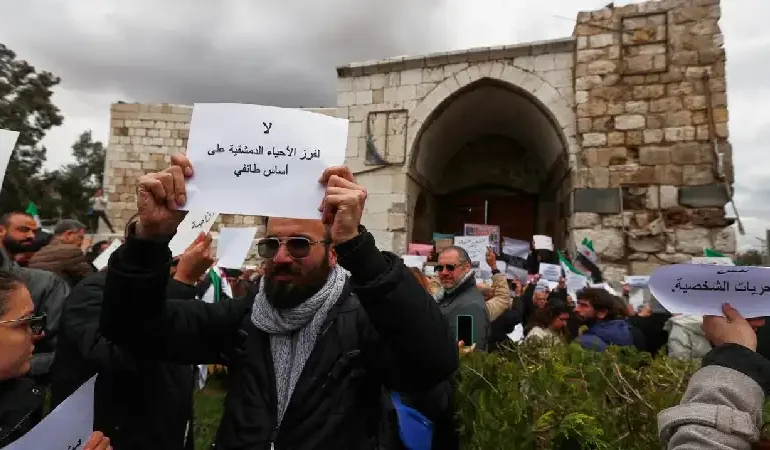

New restrictions on alcohol sales in Damascus have triggered public protests and renewed debate over personal freedoms in Syria’s capital, as residents express concern about the direction of the country’s social policies. Hundreds of people gathered in the Bab Touma district, a historically Christian area, to voice opposition to measures that limit where alcohol can be sold and consumed. Demonstrators carried signs emphasizing unity and rejecting sectarian division, while calling on authorities to protect civil liberties. The protests reflect wider anxieties about how Syria’s evolving political landscape may influence long standing cultural and social norms.
The controversy began after local authorities introduced a decree banning the sale of alcoholic beverages in restaurants and nightclubs across the capital, with a transition period requiring businesses to adjust their operations. Under the new rules, alcohol sales are largely confined to specific neighborhoods, primarily those with Christian populations, and even in those areas, consumption on site is restricted. Vendors must also comply with distance regulations from mosques, schools and government buildings. Officials stated that the decision was made in response to community concerns, but critics argue that the policy risks creating visible divisions within the city.
Residents from different religious backgrounds have expressed unease over the implications of the restrictions, particularly in a society that has historically maintained a degree of cultural diversity despite political challenges. Many protesters framed the issue as one of individual rights rather than personal preference, emphasizing that the debate extends beyond alcohol itself. Concerns have also been raised that limiting sales to certain areas could unintentionally single out minority communities, reinforcing perceptions of inequality. The presence of security forces during the demonstrations underscored the sensitivity of the issue, although the gatherings remained peaceful.
The policy emerges at a time when Syria is still navigating the aftermath of prolonged conflict and political transition. The current leadership has pledged to preserve unity and respect the country’s diverse social fabric, yet pressures from more conservative groups continue to shape public discourse. Historically, Syria maintained a secular framework that allowed for a range of personal freedoms, even amid limited political openness. The recent measures have therefore been interpreted by some observers as part of a broader debate about the balance between tradition, governance and evolving societal expectations.
In response to growing criticism, authorities issued a clarification stating that the regulations are not intended to restrict personal freedoms but rather to organize commercial practices in line with public considerations. Officials also noted that similar controls exist in many countries, though applied differently. Despite these assurances, the situation remains closely watched, as residents and observers assess how future decisions may influence social cohesion and the role of religious identity in public life. The developments highlight the complex interplay between governance, cultural diversity and the preservation of shared civic space in a changing national context.