


Vatican Hosts Global Conference on Artificial Intelligence and the Ethics of Healthcare
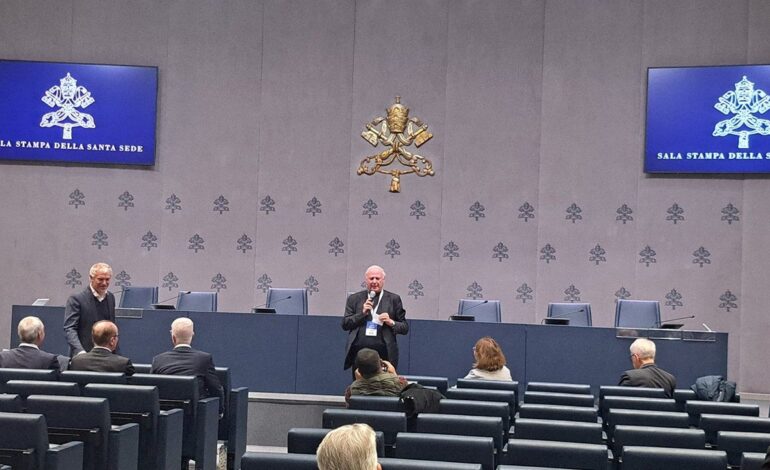

Medical professionals, theologians, and ethicists gathered at the Vatican this week to explore one of the most complex questions of modern medicine: how artificial intelligence can be used to serve humanity without diminishing human dignity. The three-day conference, titled “AI and Medicine: The Challenge of Human Dignity,” ran from November 10 to 12 and was organized by the International Federation of Catholic Medical Associations (FIAMC) and the Pontifical Academy for Life (PAV).
The event brought together experts from around the world, including representatives from India, Latin America, Europe, and the United States. Participants discussed the promise and risks of integrating AI into healthcare, from improving diagnosis and treatment to addressing ethical questions about privacy, bias, and the role of human compassion in medicine.
One of the main themes of the conference was the tension between technological advancement and the preservation of humanity in patient care. Speakers repeatedly cautioned against what they called the “temptation to humanize technology or mechanize the human being.”
Msgr. Renzo Pegoraro, President of the Pontifical Academy for Life, emphasized that healthcare must never reduce the patient to a set of numbers or data points. “We must remember that a patient is a person with emotions, fears, and dignity,” he said. “Health and illness are not merely data to be processed but experiences that must be lived and understood.”
He added that while AI can be a powerful tool, it must operate within a framework of ethical responsibility and transparency. “The question is not whether tools like ChatGPT or medical algorithms are good or bad,” he told Vatican News. “It is about how they are used, whether they are fair, non-discriminatory, and transparent.”
Dr. Otmar Kloiber, Secretary General of the World Medical Association, spoke about the rapid adoption of AI in healthcare, noting its potential to improve precision and speed in diagnosis and treatment. “Artificial intelligence can help doctors identify conditions faster, plan therapies more accurately, and sometimes even make treatments more personalized,” he said.
But he also warned that technology must not come at the cost of human connection. “There is a danger that AI could reduce personal interaction between doctors and patients,” Kloiber said. “It might become a tool for providing low-cost care only to those who cannot afford a physician, which could deepen existing social inequalities.”
He added that as technology advances, society as a whole, not just policymakers or scientists, must help shape its ethical direction. “Conferences like this are crucial,” Kloiber noted. “They bring together people with different visions, beliefs, and hopes, helping to guide how AI can serve medicine without eroding its human heart.”
Professor Therese Lysaught, a member of the Pontifical Academy, echoed these concerns, urging healthcare institutions to ensure that AI remains a support system rather than a replacement for human judgment. “Medicine is, at its core, a relationship,” she said. “AI must enhance that relationship, not weaken it.”
By the end of the conference, participants agreed that while artificial intelligence holds great potential to transform healthcare, its development must always be guided by ethics, compassion, and respect for human life.