
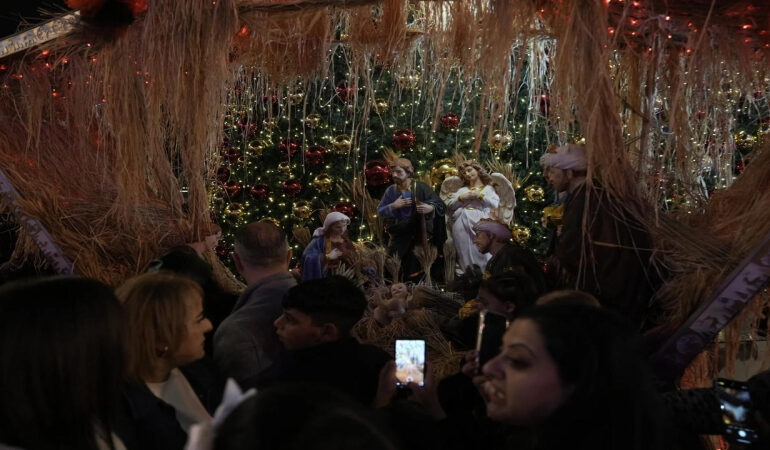

Christmas returned to Bethlehem with a renewed sense of hope as families, business owners and local officials gathered in Manger Square after two years of disruptions caused by the Gaza war and the economic hardship that followed. The celebration marked a significant moment for the West Bank city that relies heavily on religious tourism and pilgrimage, both of which collapsed when the conflict intensified across the region. This year’s lighting of the Christmas tree drew large crowds despite visible security measures and the cautious atmosphere that still surrounds daily life. For many residents, the evening signaled a turning point after long months of closed shops, empty streets and ongoing uncertainty. Local leaders noted that even a partial revival of tourism helps restore confidence across the city, supporting families who have faced dramatic losses in income and employment. The fact that families and small businesses felt prepared to welcome visitors again was interpreted as a modest but meaningful sign of resilience.
The economic impact of the past two years has weighed heavily on Bethlehem, where tourism supports the majority of households. City officials observed that when pilgrims return, the effects are immediate and widespread because hotels, restaurants, market stalls and transportation networks depend on seasonal visitors. The collapse of tourism following the outbreak of war pushed unemployment to alarming levels and forced many residents to leave in search of work. United Nations reports have underscored the severity of the downturn, describing it as one of the most profound the West Bank has faced in recent recordkeeping. Against this backdrop, the decision to proceed with Christmas celebrations was described by the mayor as an intentional step to revive hope and convey a sense of normalcy. Local authorities also stressed that the celebration was not merely symbolic but part of a broader effort to restore economic circulation and public morale in a city whose identity is deeply tied to its Christian heritage.
Crowds gathering for the tree lighting included families, vendors and residents who made long journeys through numerous checkpoints to participate in the event. Some attendees noted that tensions in surrounding areas cast a shadow over the festivities, reflecting the complex environment in which Bethlehem continues to navigate daily life. Reports of military operations and settler violence in nearby regions contributed to the atmosphere of caution that accompanies movement across the West Bank. Nevertheless, many expressed that the celebration still carried emotional importance because it reaffirmed a shared longing for coexistence and peace. The return of visitors, even in smaller numbers, offered a reminder that communities can still reach toward stability despite the challenges. As traditional music filled the square and lights illuminated the area near the Church of the Nativity, residents described the moment as one that belonged to all people, regardless of background. The celebration served as a reminder that Bethlehem’s message of hope continues to resonate far beyond its borders.