How Vatican Governance Works When Power Is Intentionally Diffused

The Vatican’s system of governance often appears complex to outside observers. Unlike centralized executive models common in modern states, authority within the Holy See is intentionally diffused across offices, councils, and consultative bodies. This structure is not accidental. It reflects centuries of institutional development designed to balance authority, continuity, and accountability within a global religious institution.
Rather than concentrating power in a single administrative chain, the Vatican distributes responsibility across multiple layers. This diffusion allows governance to function even during leadership transitions and global uncertainty. It also ensures that decisions emerge from process rather than impulse, preserving institutional stability while maintaining flexibility.
Diffused Authority as a Deliberate Design
The most important feature of Vatican governance is that diffusion of power is a deliberate design choice. Authority is shared among the papacy, dicasteries, councils, and advisory bodies. Each plays a defined role within a broader framework rather than operating as an independent center of power.
This structure reduces the risk of unilateral decision making. By requiring consultation and coordination, the system encourages discernment and accountability. Power is exercised through process rather than concentration, reinforcing stability in a global institution with diverse responsibilities.
The Role of the Roman Curia
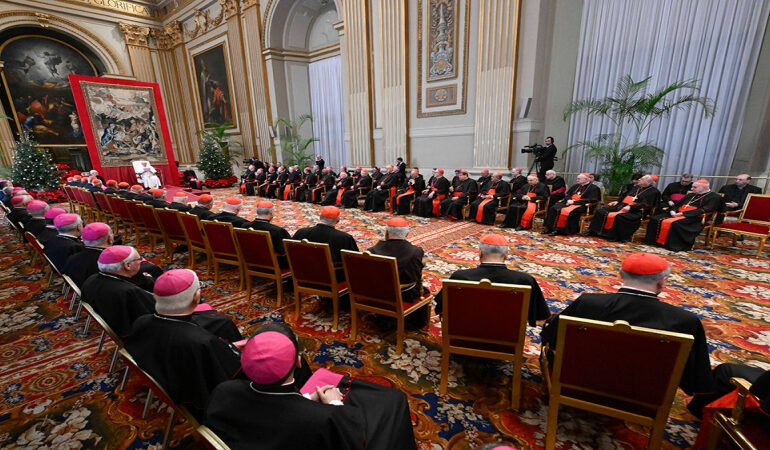
The Roman Curia serves as the administrative backbone of Vatican governance. Its dicasteries oversee specific areas such as doctrine, diplomacy, administration, and pastoral coordination. While each dicastery has defined authority, none operates in isolation.
Decisions often involve collaboration across offices, ensuring that multiple perspectives are considered. This interdependence prevents dominance by any single body and supports coherence across governance functions. The Curia’s structure exemplifies how diffusion operates in practice.
Consultation as a Governing Principle
Consultation is central to Vatican governance. Advisory councils, commissions, and expert bodies contribute to decision making without replacing formal authority. This consultative approach allows expertise to inform leadership while preserving hierarchical responsibility.
By embedding consultation into governance, the Vatican balances authority with listening. Decisions benefit from broader input without sacrificing clarity of responsibility. This principle strengthens legitimacy and reduces the likelihood of abrupt or poorly integrated policy shifts.
Papal Authority Within a Structured System
While the Pope holds supreme authority, that authority functions within an established system rather than outside it. Papal decisions are typically informed by consultation and institutional process. This ensures continuity regardless of personal leadership style.
The diffusion of power does not weaken papal authority. Instead, it anchors it within a durable structure that supports consistency. Authority is exercised through stewardship of institutions rather than direct control over every function.
Stability Through Distributed Responsibility
Distributed responsibility allows the Vatican to maintain stability during periods of transition or external pressure. When leadership changes occur, governance continues because authority is embedded within institutions rather than individuals.
This resilience is particularly important for a global Church operating across political and cultural boundaries. Diffusion ensures that no single disruption can paralyze governance. Stability emerges from shared responsibility rather than centralized command.
Accountability Without Centralization
Diffused governance also supports accountability. Clear roles and overlapping oversight reduce the risk of unchecked authority. Offices are accountable within the system rather than to a single executive chain.
This structure allows correction without confrontation. Issues can be addressed through internal mechanisms rather than public escalation. Accountability functions through process, reinforcing trust within the institution.
Governance Suited to a Global Institution
The Vatican’s governance model reflects the needs of a global institution rather than a nation state. Centralized power would struggle to accommodate diverse cultural and legal environments. Diffusion allows adaptation without fragmentation.
Local churches operate within shared doctrine while applying governance principles appropriate to their contexts. The central structure provides coordination rather than control. This balance supports unity without uniformity.
Endurance Through Institutional Design
The longevity of the Vatican’s governance model is rooted in its design. By diffusing power, the system avoids dependence on individual leadership styles or short term priorities. Endurance is built into structure.
This design allows the Church to remain functional across centuries of change. Governance evolves gradually without destabilizing core processes. Diffusion serves as a safeguard against volatility.
Conclusion
Vatican governance works through intentional diffusion of power that prioritizes consultation, shared responsibility, and institutional continuity. By distributing authority across structured bodies, the Holy See ensures stability, accountability, and resilience. This model allows governance to endure beyond individuals, sustaining coherence in a global and complex institution.