
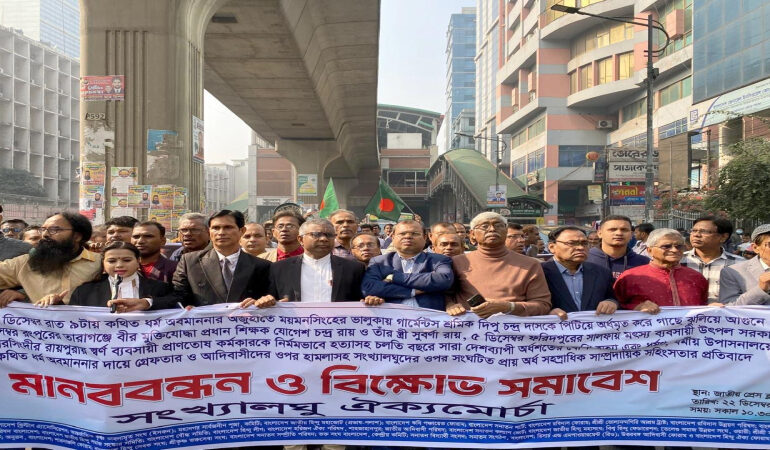

Religious minority leaders in Bangladesh have publicly accused the government of failing to protect vulnerable communities amid rising violence and political uncertainty. Speaking at a protest and human chain in Dhaka, representatives of the Bangladesh Minority Unity Front said attacks, killings, and intimidation targeting minorities have intensified without adequate response from authorities. The demonstration took place near the National Press Club and brought together Christian, Hindu, and other minority organizations concerned about deteriorating security conditions. Leaders argued that recent months have seen an increase in assaults on individuals and religious sites, leaving communities fearful and distrustful of state protection. The protest highlighted a broader anxiety that minority rights are being sidelined during a fragile political transition, with leaders warning that insecurity is becoming normalized rather than addressed through accountability and justice.
Christian leaders participating in the rally said that hundreds of incidents involving torture, harassment, and violence have been reported since the political upheaval earlier this year. According to representatives from minority associations, many cases remain unresolved, reinforcing perceptions of impunity. The leadership of the Bangladesh Christian Association stated that despite repeated appeals, there has been little visible progress toward investigations or prosecutions. Speakers emphasized that minorities often hesitate to seek redress due to fear of retaliation and lack of trust in law enforcement. The situation has been compounded by allegations that accusations of insulting religion are being used as a pretext to target minority individuals, particularly during periods of heightened political tension.
Hindu leaders at the protest echoed similar concerns, alleging that violence is being used strategically to intimidate and displace minority populations. Representatives from Hindu organizations said social media accusations have increasingly triggered mob attacks, despite claims that minorities rarely engage in such actions due to their precarious position. The protest also raised alarms about attacks on temples, churches, monasteries, and pagodas, which leaders said contribute to a sense of collective vulnerability. As the country approaches national elections scheduled for early next year, minority groups warned that fear and instability could discourage participation in civic life. They argued that without credible security guarantees, elections risk further marginalizing already exposed communities.
Government officials have attributed some recent unrest to isolated extremist groups and said arrests have been made following violent incidents. Law enforcement agencies have reportedly been placed on alert, though minority leaders remain unconvinced that these steps address the scale of the problem. The Unity Front has called for sustained protection measures, transparent investigations, and public assurances of safety ahead of the elections. Their demands reflect growing concern that political volatility is intersecting with religious identity, creating conditions where minorities bear disproportionate risk. The protests underscored a call for governance rooted in equal protection, warning that continued inaction could deepen divisions and undermine social stability.