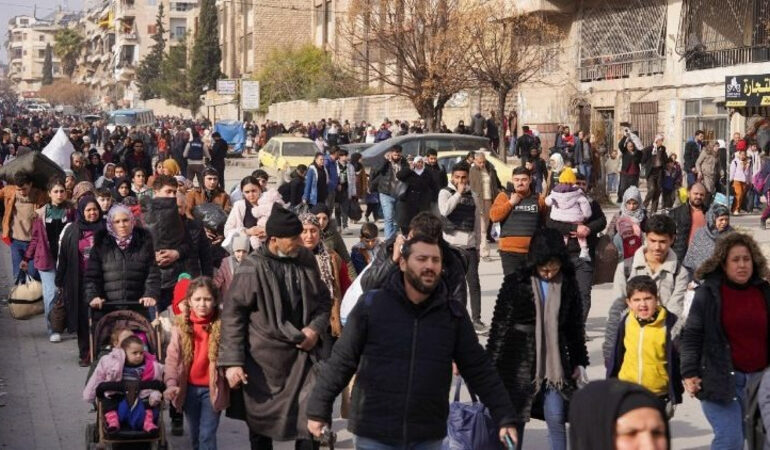

Renewed violence in Aleppo has underscored the fragile security situation still facing Syria more than a year after the collapse of central authority. Fighting erupted during the night of January 6 to 7 between Syrian government forces and the Syrian Democratic Forces, a coalition dominated by Kurdish units, turning parts of the city into active conflict zones once again. At least nine people were reported killed, marking one of the deadliest outbreaks in months and shattering a period of relative calm. As clashes continued into the following day, civilian life across Aleppo was abruptly disrupted. Flights were suspended, schools and government offices were shut down, and families living close to the front lines were evacuated under emergency measures. The return of street level fighting revived fears among residents who have endured years of instability and raised fresh doubts about the durability of post conflict arrangements.
The latest unrest comes amid stalled negotiations over the future of Kurdish armed groups within the Syrian state. An agreement signed last March had outlined a framework for integrating these forces into the national army by the end of 2025, a step widely seen as essential for restoring territorial unity. However, talks have repeatedly failed to produce tangible results, leaving the agreement largely unimplemented. The renewed clashes in Aleppo reflect how unresolved political arrangements continue to translate into security crises on the ground. With no effective mechanism to enforce ceasefires or advance integration plans, localized confrontations risk escalating into broader instability. For civilians, the breakdown of negotiations has immediate consequences, including the loss of basic services and the constant threat of displacement.
Christian communities have been particularly shaken by the resurgence of violence, as recent months have seen repeated threats to places of worship. Last June, an attack on the Mar Elias Church in Damascus claimed the lives of twenty five people, deepening fears among religious minorities about their future in the country. In Aleppo, tensions were heightened further on December 31 when a suicide attack targeting the Greek Orthodox Church of Bab al Faraj was narrowly averted. A police officer intervened and prevented mass casualties, sacrificing his own life in the process. These incidents have reinforced a sense of vulnerability among believers and clergy, who view the lack of stable governance as a direct risk to religious coexistence.
The events in Aleppo highlight the broader challenge Syria continues to face in rebuilding national cohesion after years of war and political fragmentation. While the fall of the previous regime raised hopes for a new phase of reconciliation, the persistence of armed rivalries shows how deeply divided the country remains. The inability to translate political agreements into lasting security has left cities like Aleppo exposed to sudden eruptions of violence. For observers within and beyond the region, the situation serves as a reminder that the path toward unity is neither linear nor guaranteed. Without credible political dialogue and effective protection for civilians and religious communities, Syria’s transition risks remaining stalled in a cycle of uncertainty and fear.