
Parolin Calls Europe to Renew Christian Courage in Brussels
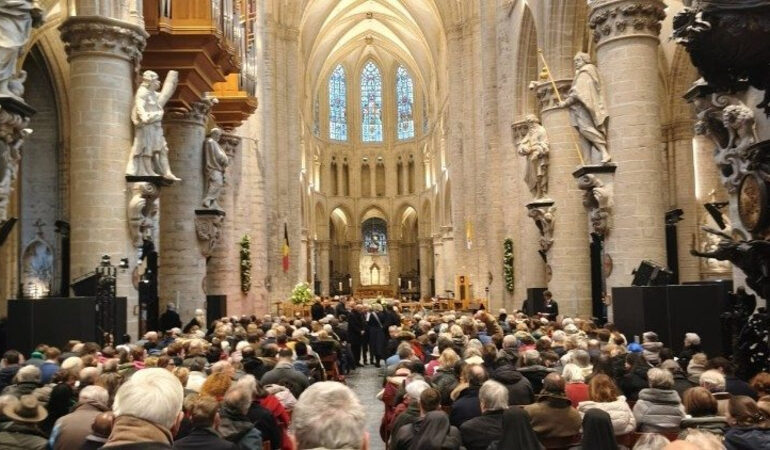

Speaking inside the Cathedral of St. Michael and St. Gudula during its 800th anniversary celebrations, Cardinal Pietro Parolin reflected on the place of Christian faith within Europe’s present uncertainty. Addressing a congregation that included members of the Belgian royal family and civic representatives, he emphasized that Christianity is not a memory detached from history but a living presence shaped by time, place, and community. He recalled that long before the Gothic cathedral took form, earlier Christian worship already rooted faith deeply in Brussels, underscoring a continuity that spans centuries. This gradual unfolding of faith, he said, mirrors the Church’s own nature, built through fidelity across generations rather than isolated moments of achievement. The cathedral itself, shaped by patience and perseverance, stands as a witness to a faith that has consistently engaged the questions, struggles, and responsibilities of each era.
Reflecting on the cathedral’s long history, Cardinal Parolin described the Church as a reality formed through the careful handing on of what has been received. Faith, he noted, grows through ordinary commitment rather than dramatic assertion, sustained by communities that safeguard and transmit belief over time. The Cathedral of St. Michael and St. Gudula, founded in the thirteenth century and developed across centuries, was presented as a symbol of this process. Its presence in the city has accompanied not only spiritual life but also social transformation, offering a space where conscience and public responsibility intersect. For the cardinal, such places remind Europe that its Christian heritage was never static or imposed, but patiently woven into daily life through service, prayer, and engagement with the realities of society.
Turning to the cathedral’s patron saints, Cardinal Parolin highlighted their enduring relevance for the Church today. Saint Michael, he explained, represents vigilance and discernment, while Saint Gudula reflects quiet perseverance and daily faithfulness. Together, they illustrate a Church called to balance truth with service and conviction with humility. From Brussels, a city shaped by encounter and dialogue and home to key institutions of the European Union, the cardinal observed that Europe is experiencing a deeper fragility extending beyond politics into cultural and interior dimensions. Fear, fragmentation, and loss of shared purpose, he said, challenge both societies and believers. Yet the Church’s mission is not to withdraw from history or dominate it, but to accompany it attentively, offering discernment and hope amid uncertainty.
Recalling figures associated with Europe’s postwar reconstruction, Cardinal Parolin warned that the greatest threat facing the Church today is not diminished numbers but the temptation toward irrelevance. Christian witness, he stressed, weakens not through size but through the loss of evangelical courage. In a European context marked by self doubt and skepticism, the Church is called to remain present as a moral and spiritual companion rather than a distant observer. Concluding his reflections, he entrusted the city of Brussels, Belgium, Europe, and the international community to prayer, expressing hope that the cathedral would continue to serve as an open home fostering justice, responsibility, and hope. In doing so, he framed Christian boldness not as confrontation, but as faithful presence grounded in service and trust.