
Leo XIV Links Baptism and Peace in Vatican Celebrations
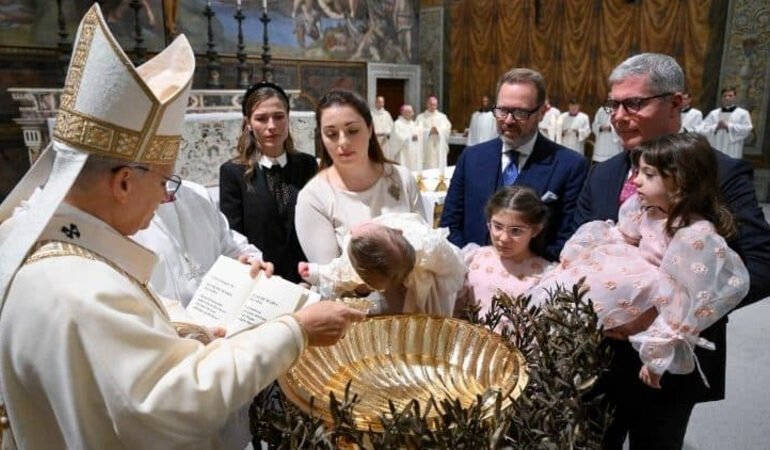

On the Feast of the Baptism of the Lord, Pope Leo XIV returned to a longstanding Vatican tradition by baptizing infants during Mass in the Sistine Chapel, offering reflections that connected faith, human dignity, and global responsibility. Celebrating the sacrament with children of Vatican employees, the Pope described baptism as the moment when life receives its deepest meaning, not only through existence but through faith. He reflected on Christ’s choice to enter history humbly, meeting humanity without distance and offering salvation through mercy rather than power. By recalling Jesus’ own baptism, Leo XIV emphasized that righteousness in the Christian sense flows from God’s initiative, transforming believers into new creatures. Addressing parents directly, he underscored faith as an essential gift, entrusted to children as naturally as food or care, forming them within the shared life of the Church.
During his homily, the Pope described baptism as a sign of death and resurrection, forgiveness and communion, rooted in Christ’s solidarity with humanity. He spoke of Jesus as light revealed in unexpected places, choosing closeness with sinners rather than separation. For the families present, Leo XIV highlighted baptism as a bond that unites households within the wider ecclesial family, sanctifying relationships across generations. He encouraged parents to nurture the faith entrusted to their children with joy and perseverance, expressing hope that the sacrament would strengthen family life amid future challenges. The celebration also marked the conclusion of the Christmas liturgical season, situating the feast as a moment of transition from contemplation of the Incarnation toward active witness in daily life.
Later the same day, Pope Leo XIV addressed the faithful during the Angelus prayer, drawing again on the meaning of Jesus’ baptism as a sign that God is neither distant nor indifferent to human suffering. He described Christ as one who comes to serve rather than dominate, offering reconciliation instead of condemnation. The Pope urged Christians to remember their own baptism as a source of light during moments of conflict and uncertainty, and as a foundation for authentic witness. He portrayed baptism as a spiritual anchor across life’s stages, offering hope in darkness and meaning amid struggle. His reflections framed the sacrament not only as a personal grace but as a call to responsibility within a wounded world.
The Angelus also carried a strong appeal for peace, as the Pope voiced concern over renewed violence in the Middle East, including developments in Syria and Iran. He prayed for stability and dialogue in regions marked by unrest, while also renewing his plea for peace in Ukraine. Leo XIV condemned attacks on civilian infrastructure that have left many without heat or electricity during winter conditions, urging attention to the human cost of conflict. By linking liturgical celebration with global concern, the Pope reinforced a central theme of his pontificate: that faith and prayer cannot be separated from moral responsibility toward suffering peoples. His words positioned baptism as both a gift received and a mission lived in solidarity with others.