

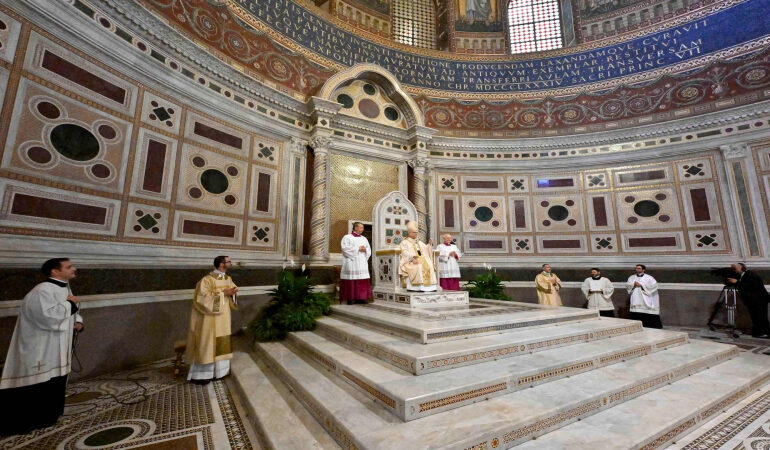

Pope Leo XIV has decided to celebrate the Mass of the Lord’s Supper on Holy Thursday at the Archbasilica of St. John Lateran, reaffirming a long-standing Roman tradition closely tied to the pope’s role as Bishop of Rome. The celebration, scheduled for early April, marks a return to the cathedral that holds particular symbolic significance as the mother church of the Diocese of Rome. For more than a decade, the Holy Thursday liturgy had been celebrated in alternative settings, reflecting a pastoral emphasis on proximity to marginalized communities. With this decision, the current pontificate signals a renewed attention to the cathedral liturgy that gathers priests and faithful of the diocese around their bishop. Church officials note that the choice does not diminish concern for the poor, but rather highlights the importance of the diocesan dimension of the papal ministry, especially during the central liturgical moments of Holy Week.
The Archbasilica of St. John Lateran has historically been the focal point of Holy Thursday celebrations in Rome, particularly the evening Mass that commemorates the institution of the Eucharist and the commandment of fraternal service. According to those responsible for the basilica’s liturgical life, the return to this setting restores broader participation by clergy of the diocese, who are ordinarily present for this celebration. During previous years, the limited capacity of alternative locations made such participation difficult. Observers emphasize that the period in which the Lateran was set aside should be understood as a distinct pastoral phase rather than a permanent shift. The decision to resume the traditional celebration reflects continuity with centuries of practice while remaining open to pastoral initiatives throughout the liturgical year. It also underscores the pope’s visible presence within the life of the local Church of Rome, particularly at moments of strong ecclesial identity.
Holy Thursday has long held a unique place in the Church’s liturgical calendar, combining remembrance of the Last Supper with gestures that express service and humility. The rite of washing feet, rooted in the Gospel account of Christ’s actions, has taken various forms across history, sometimes linked directly to the Mass and at other times celebrated separately. Liturgical scholars recall that reforms over the centuries have sought to balance historical fidelity with pastoral clarity. In recent decades, the Holy Thursday celebrations in Rome have been divided between the Vatican and the Lateran, reflecting practical and symbolic considerations. By returning the evening liturgy to the cathedral, Pope Leo XIV reinforces the connection between the Eucharist, episcopal ministry, and the life of the diocesan community. The decision highlights a vision of tradition not as repetition, but as continuity that remains attentive to meaning, participation, and ecclesial unity.