


Pope Leo Urges Balance of Truth and Mercy in Church Justice
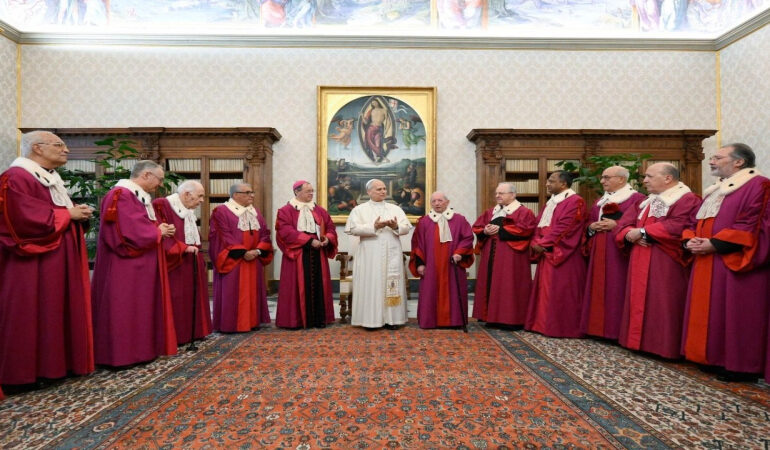

Pope Leo XIV addressed officials of the Tribunal of the Roman Rota at the Vatican during the opening of the tribunal’s judicial year, urging Church judges to uphold truth with rigor while avoiding rigidity and to practice charity without neglect. Speaking to the prelate auditors, the Pope emphasized that justice within the Church must remain closely linked to both truth and mercy, describing the two as inseparable dimensions rooted like God. He thanked the members of the tribunal for their service, describing their work as essential to the universal judicial mission of the Church. The Roman Rota serves as the Church’s highest appellate tribunal and plays a central role in safeguarding rights within ecclesial structures while ensuring coherence in canonical jurisprudence across dioceses worldwide.
In his remarks, Pope Leo reflected on the longstanding tradition of papal guidance to the Roman Rota, noting that the relationship between justice and truth has been a consistent concern from earlier pontificates to the present. He warned that judicial activity within the Church often encounters tension between objective truth and pastoral sensitivity, requiring careful discernment. According to the Pope, excessive identification with difficult personal circumstances can risk weakening the search for truth, particularly in sensitive cases such as matrimonial nullity. He cautioned that compassion, if detached from objective evaluation, may lead to decisions lacking a solid juridical foundation. Such outcomes, he said, risk undermining the credibility and equity of ecclesiastical justice and weakening confidence in Church legal processes.
At the same time, the Pope cautioned against a purely formal or detached application of truth that neglects the demands of charity and respect for persons. He said justice that ignores mercy risks becoming cold and disconnected from the pastoral mission of the Church. Referring to the Christian understanding of justice, he stressed that truth must be lived and enacted, not merely affirmed in abstract terms. Judicial procedures, he explained, are not instruments of opposing interests but necessary tools for discerning truth in concrete cases. He emphasized that failure to observe fundamental principles of justice, including consistency and fairness, damages ecclesial communion and weakens trust in canonical institutions.
Pope Leo also addressed specific aspects of Church judicial practice, including the shorter process for declarations of matrimonial nullity overseen by diocesan bishops. He stressed that the apparent clarity of a case must be carefully examined through proper procedure and that due process remains essential in confirming nullity or determining the need for an ordinary trial. The Pope underlined the importance of continued scholarly study and faithful application of canon law in accordance with Church teaching. Concluding his address, he entrusted the work of the tribunal to the intercession of the Virgin Mary, presenting her as a model of justice united with charity, and reaffirmed the responsibility of Church judges to serve truth while remaining attentive to the human realities before them.