Bishop Kevin Rhoades Frames Migration Crisis as Moral Test for the Church
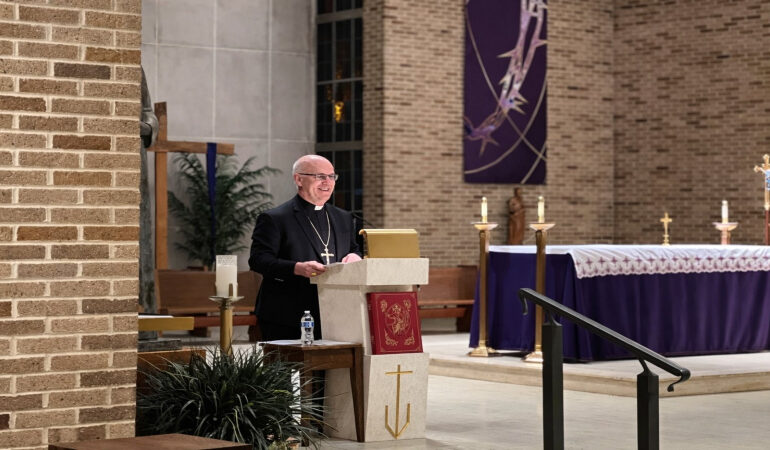

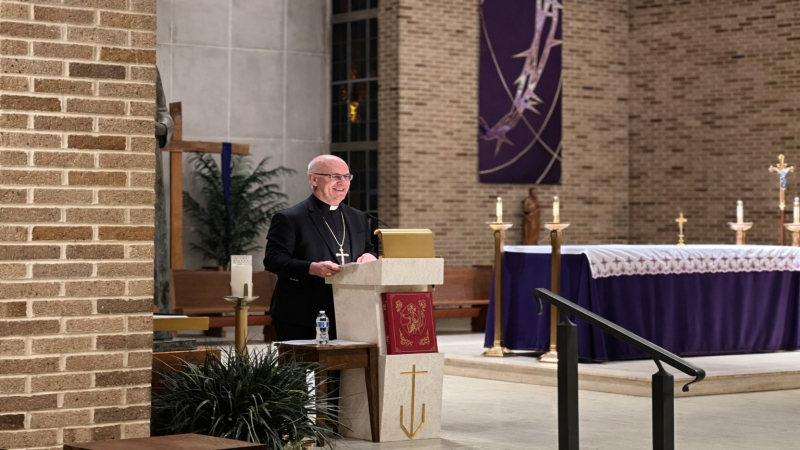
At Holy Cross College in South Bend, Kevin Rhoades delivered a theological reflection on what he described as an immense global migration crisis, urging Catholics to respond with what he called the mind and heart of Christ. Addressing students, faculty, and community members, the bishop of the Diocese of Fort Wayne South Bend grounded his remarks in Scripture, Catholic social teaching, and current international data.
Citing recent United Nations figures, he noted that more than 117 million people worldwide are forcibly displaced. Of these, over 42 million are refugees, nearly 68 million are displaced within their own countries, and millions more are seeking asylum. He emphasized that more than 40 percent of refugees are children and that most live within family units, reminding his audience that these statistics represent real human lives marked by trauma and uncertainty.
Bishop Rhoades argued that Christian reflection on migration must begin with biblical revelation rather than partisan politics. He pointed to the Exodus narrative and the command in Leviticus to treat the stranger as one of one’s own. He also referenced the flight of the Holy Family into Egypt, described by Pope Pius XII as the archetype of every refugee family, and the teaching of Jesus in Matthew 25 that welcoming the stranger is equivalent to welcoming Christ.
Drawing on Catholic social doctrine, he highlighted the principle of the universal destination of goods, which teaches that the earth’s resources are intended for all. Christians, he said, are stewards rather than absolute owners and have moral obligations toward those in need, including migrants and refugees. He also reiterated the Church’s preferential option for the poor, insisting that indifference to human suffering contradicts discipleship.
At the same time, Bishop Rhoades underscored what he called the right not to migrate. People should be able to live in safety and dignity within their own homelands. He referenced the work of Catholic Relief Services, which operates in more than 100 countries to address root causes of displacement. He warned that recent reductions in international aid funding have significantly impacted humanitarian programs.
Regarding the right to migrate, he affirmed that when life and dignity are threatened, individuals have the right to seek protection elsewhere, including asylum. However, he also acknowledged the responsibility of nations to regulate borders in accordance with the common good, citing the Catechism’s teaching that prosperous nations should welcome those in need to the extent they are able.
Concluding his lecture, the bishop returned to the theme of solidarity, echoing John Paul II, who defined it as a firm commitment to the common good. He urged Catholics to see migrants not as abstract categories but as brothers and sisters whose plight calls for compassion, justice, and concrete action.