
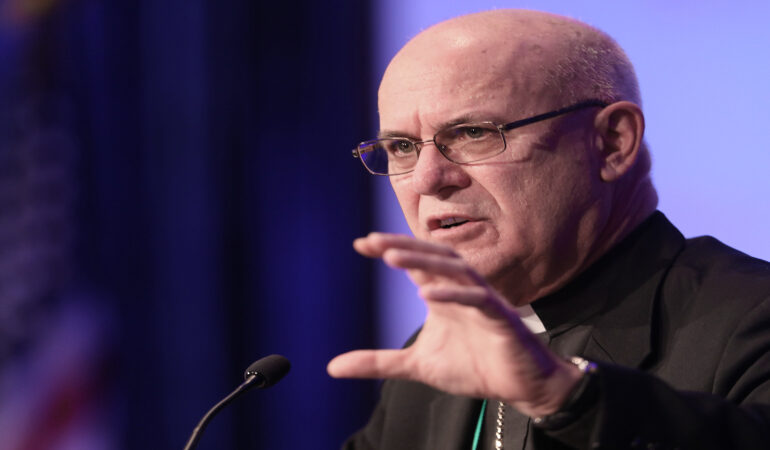

Bishop Kevin Rhoades of Fort Wayne South Bend has called on the University of Notre Dame to reverse its decision to appoint a faculty member who publicly supports legal abortion as director of one of its research institutes, raising concerns about Catholic identity and leadership at the university.
In a February 11 statement, Bishop Rhoades expressed strong opposition to the appointment of Associate Professor Susan Ostermann as director of the Liu Institute for Asia and Asian Studies, part of the Keough School of Global Affairs. The appointment is scheduled to take effect July 1.
The bishop, who also chairs the U.S. Conference of Catholic Bishops Committee on Doctrine, said the professor’s public advocacy for abortion rights and past statements critical of pro life positions conflict with a core principle of justice central to the Catholic mission of Notre Dame. He stated that the appointment has caused confusion and concern among the faithful in the diocese and beyond.
The controversy has also drawn internal reaction at the university. According to campus reports, at least two faculty members associated with the Liu Institute resigned from their roles in protest following the announcement. Critics have cited op eds co authored by Ostermann in which abortion was defended as a legal right and crisis pregnancy centers were sharply criticized.
In his statement, Bishop Rhoades referenced the Catechism of the Catholic Church, which teaches that human life must be respected and protected from conception to natural death. He also cited Ex Corde Ecclesiae, the apostolic constitution of St. John Paul II outlining the responsibilities of Catholic universities and the role of the local bishop in safeguarding Catholic identity.
The bishop argued that academic freedom, while essential to research and scholarship, differs from administrative leadership appointments that shape the public witness of a Catholic institution. He said leadership positions carry responsibility for upholding the university’s stated commitment to the dignity of human life and integral human development.
Ostermann, in a statement, affirmed her commitment to academic freedom and to supporting diverse research within the institute. She emphasized that her role as director would not involve advancing a personal political agenda but facilitating scholarly work in line with the university’s broader mission. She also stated respect for Notre Dame’s institutional position on the sanctity of life.
Bishop Rhoades encouraged prayer for the university and urged its leadership to reconsider the appointment before it takes effect. He noted that many faculty, students and alumni have expressed sadness and confusion over the decision. While acknowledging the complexity of academic governance, he maintained that clarity regarding Catholic teaching on life issues remains essential for institutions that publicly identify with the Church.
The situation highlights ongoing debates about the relationship between Catholic doctrine, academic freedom and leadership roles within Catholic higher education in the United States.