




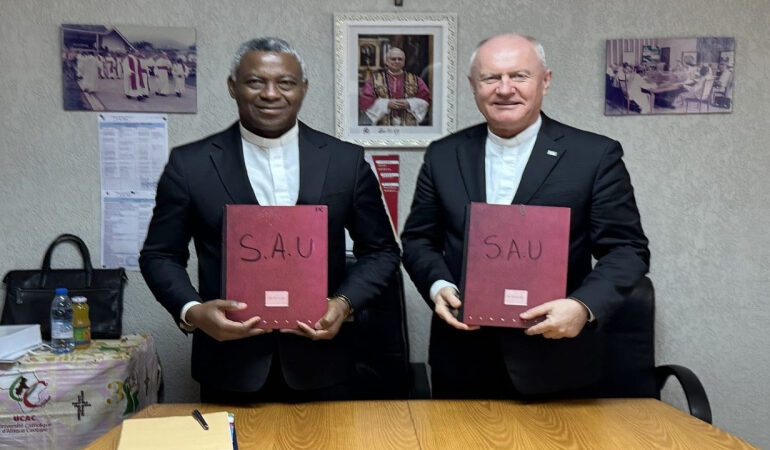

The Catholic University of Central Africa in Cameroon has expanded its international academic network through a new cooperation agreement with the John Paul II Catholic University of Lublin in Poland, one of Europe’s largest Catholic universities. The partnership aims to strengthen Catholic education as a force for social development, intercultural dialogue and community building.
The agreement was signed in February by the rectors of the two institutions, Fr. Prof. Thomas Bienvenu Tchoungui of the Catholic University of Central Africa and Fr. Prof. Mirosław Kalinowski of the John Paul II Catholic University of Lublin. Their collaboration follows earlier discussions held at the Vatican, where both leaders recognized the value of deeper academic ties between Africa and Europe.
The Catholic University of Central Africa, based in Yaoundé, serves not only Cameroon but also other countries in the region, including Chad, Gabon, Guinea, Congo and the Central African Republic. Established more than three decades ago by the Conferences of Bishops of Central Africa, the university has focused on educating leaders and professionals committed to serving the Church and society. Its academic programs span theology, philosophy, social sciences, law and health sciences, with a consistent emphasis on human dignity and integral development.
For its part, the John Paul II Catholic University of Lublin has over a century of academic tradition. Karol Wojtyła, who later became Pope John Paul II, was among its professors. Today the university educates nearly 10,000 students from Poland and more than 45 other countries, including Ukraine, Belarus, Spain, Central Asian nations and the United States. Its international profile and research initiatives continue to expand.
According to Fr. Prof. Kalinowski, the partnership extends beyond a simple exchange of knowledge. He emphasized that Catholic higher education must combine academic excellence with spiritual formation that responds to contemporary challenges. The cooperation is expected to include student and faculty exchanges, joint research projects and shared teaching initiatives.
Both institutions view the agreement as an opportunity to integrate European academic experience, particularly in the humanities and social sciences, with what has been described as an African existential approach to social realities. In the African context, education is closely linked to community building and concrete responses to economic and social challenges. European experience in intercultural dialogue, public ethics, humanistic ecology and educational theory may find practical application in that setting.
At the same time, the African university brings perspectives that highlight the interplay between faith, social life and daily existential concerns, areas sometimes less visible in European academic discourse. The collaboration also opens the door to joint research on migration, cultural transformation and ethical questions arising from technological change and artificial intelligence.
The agreement reflects a broader vision of Catholic universities as partners in a shared mission rather than competitors. By fostering cooperation across continents, the two institutions aim to contribute to academic growth, social responsibility and the Church’s educational mission in a rapidly changing world.