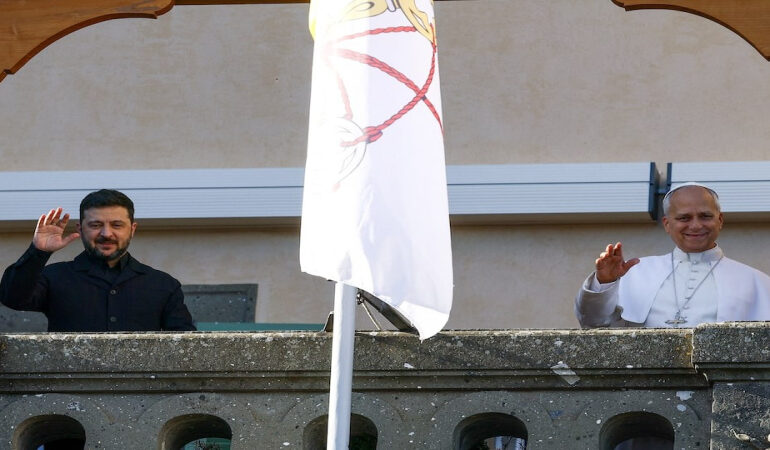

Pope Leo’s remarks following his meeting with Ukrainian President Volodymyr Zelenskiy have sharpened global attention on Europe’s responsibility in shaping a realistic pathway toward ending the conflict. His comments, delivered at Castel Gandolfo, centered on the need for European nations to be directly involved in any credible peace framework, emphasizing that the war’s geographic and political realities demand European participation rather than peripheral consultation. By highlighting Europe’s unity as a decisive factor, he signaled concern that negotiation models developed outside the continent risk overlooking the security architecture that has underpinned Europe for decades. Pope Leo acknowledged that divergent political messages circulating across the Atlantic have created uncertainty, and he warned that weakening historic alliances could carry long-term consequences for global stability. His tone remained measured, yet it reflected a growing belief within Vatican circles that multilateral cooperation cannot succeed if Europe is treated as secondary to broader geopolitical strategies.
The meeting with Zelenskiy further underscored the Vatican’s continuing engagement in humanitarian and diplomatic initiatives, particularly in matters involving displaced civilians and children taken into Russian-controlled territories. By affirming the Holy See’s willingness to serve as a channel for dialogue, Pope Leo reinforced the Vatican’s longstanding belief that neutral mediation retains value even when major powers disagree on the contours of a settlement. Zelenskiy expressed appreciation for the Church’s consistent appeals for a just peace, positioning the Vatican as an institution capable of maintaining communication lines during moments of deep political strain. While the Pope refrained from directly critiquing any specific government’s peace proposal, he made clear that frameworks excluding Europe run counter to practical and ethical considerations. His reflections suggested that durable stability requires negotiated outcomes shaped by those who will live with their consequences, and he affirmed that European leaders still possess the capacity to steer diplomacy toward balanced security guarantees.
Pope Leo also addressed the possibility of visiting Kyiv, noting that such a trip would depend on conditions that allow for meaningful pastoral and diplomatic engagement rather than symbolic gestures. His consideration of a visit signals the Vatican’s desire to remain visibly committed to humanitarian concerns while navigating the complexities of wartime diplomacy. Comments concerning international alliances revealed broader anxieties that narratives portraying Europe as politically fragile risk undermining cooperation at a moment when unity is essential for protecting continental security. The Pope’s message aligned with Zelenskiy’s insistence that peace must not reward aggression or disregard the suffering caused by displacement and conflict. By emphasizing realism, shared responsibility and moral clarity, Pope Leo positioned the Vatican as a stabilizing voice encouraging renewed commitment to multilateral action while avoiding direct entanglement in geopolitical rivalries.