



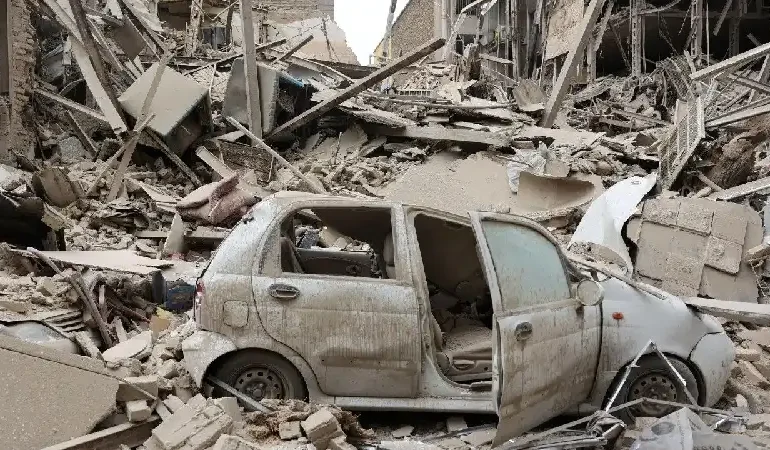

Intense overnight bombing was reported in Tehran as Israel expanded its military campaign against Iranian targets, marking a significant escalation in a conflict that has now entered its third week. The Israeli military confirmed that it carried out a wide series of strikes aimed at what it described as strategic infrastructure linked to Iran’s military and security networks. Residents in the Iranian capital reported explosions across several areas during the night, raising fears of further instability across the region. The developments come amid rising international concern that the confrontation between Israel and Iran could expand into a broader regional conflict affecting several Middle Eastern states.
Israeli officials stated that the latest operations targeted sites connected to Iran’s defense and logistical systems in several major cities including Tehran, Shiraz, and Tabriz. According to the Israeli military, the strikes focused on facilities believed to be used for coordinating weapons transfers and military planning. Among the targets reportedly hit was an aircraft located at Tehran’s main airport which Israeli authorities claim had previously been used by senior Iranian officials for strategic travel and military coordination. The strikes represent one of the most extensive operations carried out by Israel inside Iranian territory since the current confrontation began earlier this month.
Regional tensions have continued to spread beyond Iran’s borders as military actions also intensified in neighboring Lebanon. Israeli forces announced the beginning of what they described as limited and targeted ground operations against Hezbollah positions in southern Lebanon. The campaign against the Iran backed group has already triggered a significant humanitarian situation, with international agencies reporting large scale displacement in affected areas. According to figures cited by humanitarian organizations, more than eight hundred thousand people in Lebanon have been forced to leave their homes as fighting and cross border exchanges of fire continue to escalate.
The growing conflict is also raising alarm about the stability of global energy routes and commercial transportation networks. United States President Donald Trump confirmed that discussions are underway with several countries regarding efforts to ensure the continued security of the Strait of Hormuz. The narrow waterway between Iran and the Arabian Peninsula is one of the world’s most important energy corridors, carrying nearly twenty percent of global oil shipments. Any disruption to traffic in the strait could have immediate consequences for energy markets and international trade, prompting governments and financial institutions to closely monitor the evolving situation.
European officials are also examining possible diplomatic and security responses as the crisis deepens. The European Union’s foreign policy leadership has indicated that member states will hold discussions on potential measures to maintain the safety of maritime traffic in the Gulf region. European governments have expressed concern that further escalation could destabilize international shipping routes and worsen economic uncertainty at a time when global markets are already facing volatility. Diplomatic channels remain active as several governments attempt to encourage de escalation and prevent the conflict from expanding into a wider confrontation involving multiple regional powers.
The broader impact of the conflict is already being felt across the Middle East’s transportation and aviation sectors. At Dubai International Airport, flight operations were partially suspended following reports of an Iranian missile strike near the airport’s vicinity. Authorities later confirmed that some flights had resumed after temporary security measures were implemented. Airlines and aviation authorities across the region are continuing to review flight routes and safety procedures as military activity increases across several air corridors commonly used for international travel.
Military analysts warn that the situation remains fluid as both sides continue to demonstrate their ability to carry out operations across a wide geographic area. The latest strikes in Iran, combined with ongoing military actions in Lebanon and the heightened focus on strategic waterways such as the Strait of Hormuz, indicate that the conflict is entering a more complex phase. Governments, international organizations, and humanitarian agencies are closely monitoring developments while urging restraint to prevent further civilian suffering and regional instability.