
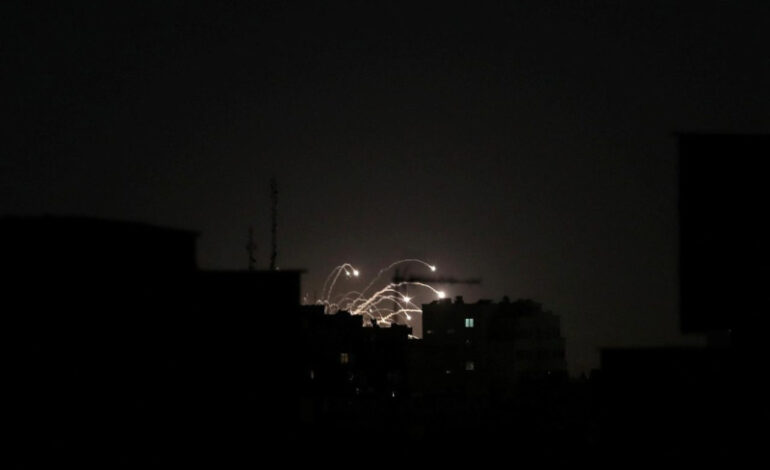

Israel carried out a new series of military strikes against targets in Iran overnight as the conflict between the two countries entered its seventh day, intensifying fears of a broader regional confrontation. Reports from Tehran described the bombardment as one of the most severe nights since hostilities began, with residents hearing repeated explosions across parts of the capital. Military officials in Israel confirmed that fighter jets conducted multiple operations targeting strategic infrastructure linked to Iran’s defense network. The escalation follows several days of retaliatory attacks between the two countries and comes amid growing international concern that the conflict could expand beyond their borders.
Iranian authorities said one of the targets struck during the operation included an underground bunker reportedly designed for use by former Supreme Leader Ayatollah Ali Khamenei. According to officials, the attack involved approximately fifty Israeli fighter jets operating in coordinated waves. Israeli military sources also confirmed a broader round of operations across the region, including strikes directed toward positions associated with Iranian backed groups. At the same time, the Israel Defense Forces announced what it described as a large scale wave of attacks in Beirut, suggesting the conflict is increasingly spreading across multiple fronts in the Middle East.
Iran responded with additional missile and drone launches targeting Israeli territory and allied military facilities in the region. The Islamic Revolutionary Guard Corps said its forces carried out attacks against American and Israeli bases in the Persian Gulf as well as strategic locations in Tel Aviv, Ben Gurion Airport and a military complex near Haifa. Regional governments including Saudi Arabia, Qatar and Bahrain reported intercepting incoming projectiles within their airspace during the night. The developments illustrate how quickly the confrontation between Israel and Iran has begun to involve multiple regional actors, raising concerns about the stability of the broader Gulf and Eastern Mediterranean region.
International reactions have continued to intensify as governments prepare for possible further escalation. United States Defense Secretary Pete Hegseth said American military operations connected to the conflict could increase significantly in the coming period. According to U.S. defense officials, additional deployments and operational measures are being considered to protect American forces and regional allies. Meanwhile European governments are focusing on the safety of their citizens across the Middle East as security conditions remain unpredictable and travel routes become increasingly disrupted.
The United Kingdom has begun organizing additional evacuation efforts for its nationals in the region. British authorities confirmed that further repatriation flights are being planned from Oman after the first government chartered aircraft carrying evacuees from the Middle East arrived safely at London Stansted Airport. The British government has also updated travel guidance for Cyprus, warning that the risk of terrorism connected to the wider regional tensions cannot be ruled out. Officials said there remains a heightened global threat to British interests and citizens abroad, particularly from extremist groups that may seek to exploit the current conflict.
The ongoing confrontation between Israel and Iran is now being closely monitored by governments and international organizations as military exchanges continue across several countries in the region. Analysts warn that the combination of direct strikes, proxy involvement and missile activity across multiple territories increases the risk of a wider regional conflict. As diplomatic efforts struggle to keep pace with rapidly evolving military developments, the Middle East faces a period of growing uncertainty with significant humanitarian and geopolitical consequences.