Poland Wins 18th European Futsal Championship for Priests as Croatia and Portugal Take Podium Spots
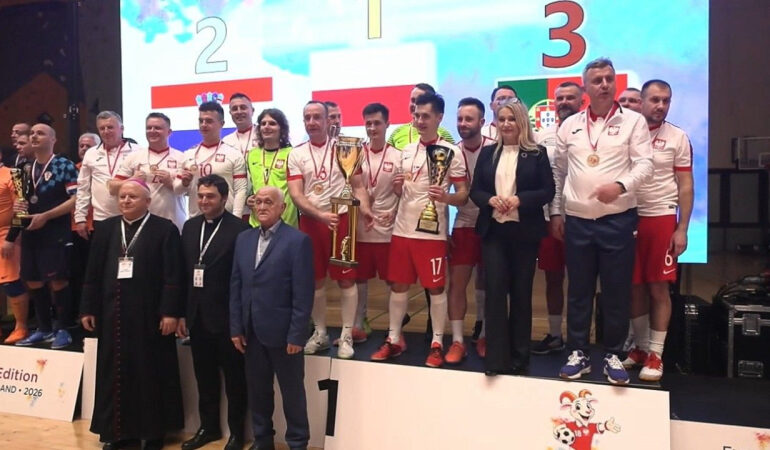

The Polish national team of priests secured the gold medal at the 18th European Futsal Championship for Priests, marking the tenth time Poland has won the title in the tournament’s history. Croatia finished in second place, while Portugal claimed the bronze, rounding out the podium at this year’s competition held in Lublin.
Fr. Marek Łosiak, captain of the Polish team, expressed gratitude and joy after the victory. He said the team hoped not only to celebrate with supporters but also to show that priests can witness to faith through passion and talent. For him and his teammates, the championship represents more than athletic success. It is an opportunity to demonstrate that priestly life includes fraternity, discipline and healthy recreation grounded in faith.
The tournament brought together 18 national teams from across Europe, including participants from Albania, Austria, Italy, Hungary, the Czech Republic, Slovakia and Ukraine. Hosted by the city of Lublin and the Archdiocese of Lublin, matches were played in university sports halls throughout the city. The event combined competitive intensity with an atmosphere of friendship and mutual respect among clergy from different cultures and pastoral contexts.
A message of encouragement was sent to the teams and organizers by Cardinal José Tolentino de Mendonça, Prefect of the Dicastery for Culture and Education. In his message, he thanked Archbishop Stanisław Budzik of Lublin for hosting the championship and acknowledged the priests and institutions involved in organizing the event. Recalling reflections made during the recent Jubilee of Sport, he noted that sport has played a meaningful role in the lives of many contemporary saints, serving both as personal discipline and as a means of evangelization.
The championship, first launched in Austria in 2005, has grown into a recognized symbol of unity among European priests. Over nearly two decades, it has provided a space where clergy can build fraternity beyond national boundaries while promoting physical well being and teamwork. The annual gathering underscores the Church’s recognition of sport as a constructive dimension of human development that fosters community and resilience.
Beyond the matches themselves, the event offered moments of shared prayer, cultural exchange and informal conversation among participants. For many priests, the championship provides a rare chance to encounter fellow clergy from different parts of Europe in a setting that encourages both friendly rivalry and deeper bonds of communion.
Poland’s latest victory reinforces its longstanding strength in the tournament, but the broader significance of the event lies in its ability to unite priests in a common experience that integrates faith, fellowship and athletic excellence within the wider life of the Church.