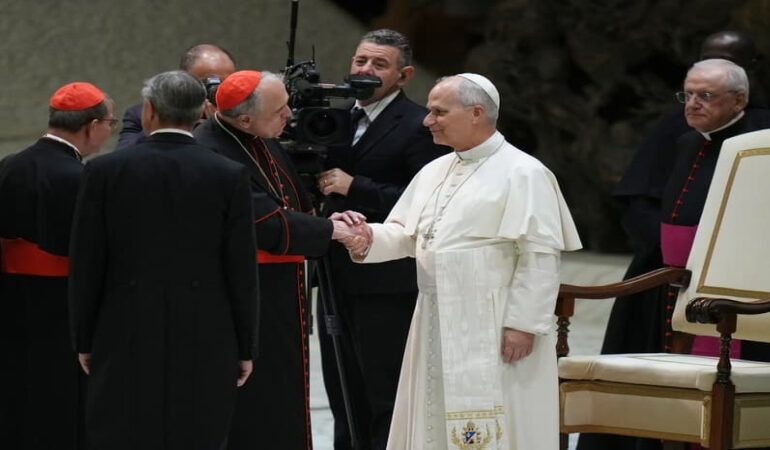

A new phase of leadership began in Vatican City as Pope Leo XIV gathered Cardinals from around the world and asked them to help identify priorities for the Church over the next two years. Around 170 Cardinals assembled for the first Extraordinary Consistory of his pontificate, marking a shift toward broader consultation and shared discernment. In opening remarks, the Pope invited them to speak freely about what should guide his ministry and the work of the Holy See in the near future. He described the short but intense meeting as a moment meant to set direction rather than produce immediate decisions. The gathering followed closely after the conclusion of the Jubilee Year, underscoring the Pope’s intention to look ahead with renewed focus. The Consistory was presented as a space for listening, dialogue, and collaboration, reflecting a desire to strengthen collegial responsibility within the global Church.
The Cardinals were initially offered four broad themes for discussion and were asked to select two as priorities. After deliberation, they chose to focus on synodality and the missionary identity of the Church, setting aside debates on liturgy and internal Vatican reform for the moment. Vatican officials noted that this choice reflected a sense of urgency about how the Church listens and responds to the faithful and how it proclaims the Gospel in contemporary society. The decision also signaled continuity with recent pastoral emphases, while avoiding topics known to generate sharp internal division. Participants described the process as intentional and reflective, allowing diverse perspectives to surface without pressure to resolve longstanding disagreements. The emphasis was placed on how the Church walks together and reaches outward, rather than on internal structures alone.
Earlier the same day, Pope Leo offered a strong indication of the theological direction he intends to pursue by highlighting the enduring importance of the Second Vatican Council. Addressing the faithful at his weekly general audience, he announced that future catechesis would focus on rereading key Council documents. He encouraged Catholics to return directly to these texts rather than rely on interpretations shaped by later debates. Describing the Council’s teaching as a guiding light for the Church’s journey today, he pointed to its call for active participation, missionary engagement, and dialogue with the modern world. The Pope’s emphasis suggested a desire to root renewal in continuity rather than rupture, while acknowledging that Vatican II remains a living reference point shaping pastoral life and ecclesial identity.
By convening the Consistory so early in his pontificate, Pope Leo signaled a governing style attentive to consultation and shared responsibility. The move was widely seen as a response to long standing concerns among Cardinals about limited involvement in decision making. The Pope’s request for advice framed the College of Cardinals not as a ceremonial body but as an active partner in discernment. Observers noted that the focus on mission and synodality reflects a Church seeking credibility through closeness to the faithful and clarity of purpose. As discussions continue, the Consistory stands as a symbolic starting point for a pontificate defined by listening, continuity, and an outward looking vision of the Church’s role in the world.