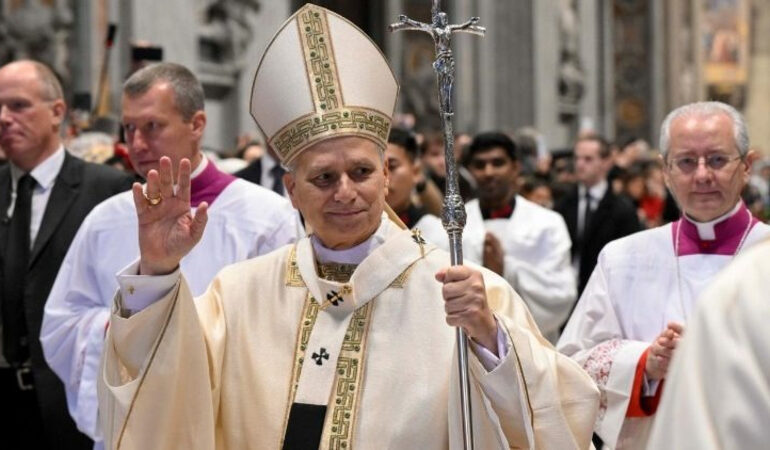

Pope Leo XIV has quietly introduced a new pastoral staff into papal liturgical life, a gesture rich in symbolism that reflects continuity with tradition while offering a distinct theological emphasis for the new pontificate. The staff was first used on January 6 during the Solemnity of the Epiphany and the closing of the Holy Door at Saint Peter’s Basilica, moments that already carry deep ecclesial significance. According to Vatican officials, the design reflects a deliberate choice to root the papal ministry in the Paschal Mystery, presenting Christ not in suffering but in glory. The introduction of the new staff is not a break with the past but a visual statement aligned with how the Church understands mission, hope, and redemption in the present moment.
The imagery of the new pastoral staff centers on the Risen Christ, portrayed with a glorified body ascending to the Father while still bearing the wounds of the Passion. These wounds are presented not as signs of defeat but as luminous marks of victory, affirming that suffering is not erased but transformed. Vatican explanations emphasize that this symbolism reflects the heart of apostolic proclamation, where the Cross and Resurrection are inseparable. In this interpretation, the staff becomes more than a ceremonial object, serving instead as a catechetical sign that places the mystery of redemption at the center of the Pope’s pastoral witness. The emphasis on resurrection also resonates with a world marked by conflict and uncertainty, offering a visual language of hope rather than lament.
Historically, the use of a pastoral staff by the Roman Pontiff has not been consistent with the broader episcopal tradition. For centuries, Popes relied on the ferula as a sign of spiritual authority and governance, primarily outside regular liturgical celebrations. Its use was limited to specific rites, such as the opening of Holy Doors or the consecration of churches. A significant shift occurred in the twentieth century when Pope Paul VI introduced a pastoral staff bearing the figure of Christ crucified, an innovation that gradually became a familiar element of papal liturgies. That decision shaped the visual identity of the modern papacy, with successive Popes adopting variations that reflected their theological and pastoral priorities.
Within this lineage, the new staff used by Pope Leo XIV signals a continuity that is interpretive rather than imitative. By presenting Christ in glory rather than bound to the Cross, the symbolism draws attention to fulfillment rather than suffering alone. Vatican officials have framed this choice as consistent with the Church’s proclamation that death no longer has the final word. In the early days of the pontificate, the gesture suggests a preference for teaching through symbols that speak quietly but enduringly, reinforcing continuity while subtly shaping how the papacy is visually and theologically perceived.