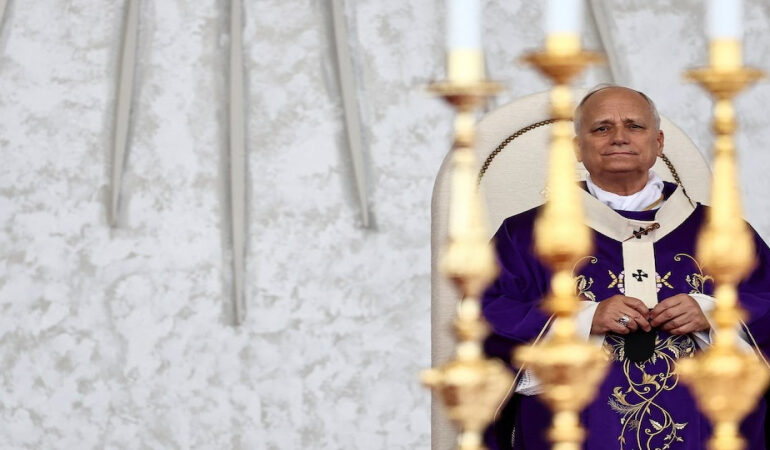

Pope Leo urged restraint from the United States as Washington considers how to approach the political and humanitarian crisis in Venezuela, stressing that military intervention would risk destabilizing an already fragile regional environment. Speaking aboard the return flight from his first overseas trip, the pontiff noted that responsible statecraft requires careful evaluation of consequences before engaging in actions that could intensify hardship for civilians. He advised that diplomatic channels and economic measures, if used ethically, can provide structured pathways for negotiation without exposing populations to the dangers associated with armed conflict. The pope indicated that efforts focused on creating space for dialogue could be more effective in encouraging meaningful change, especially in contexts where prolonged distrust has complicated international involvement. Observers following the Church’s approach to governance and ethics have emphasized that his remarks echo longstanding Vatican principles favoring conflict de-escalation, social stability and the preservation of institutional integrity during political uncertainty. His comments also carry weight as Washington evaluates its strategy while acknowledging concerns about illicit activity linked to Venezuelan networks, which Caracas denies and frequently characterizes as politically motivated allegations.
During his exchange with journalists, Pope Leo said that political communication coming from Washington appeared inconsistent, noting that alternating signals make it difficult for the international community to interpret the direction of U.S. policy. He referenced reports of intensified military activity in the Caribbean and the public discussion of possible operational plans, while at the same time highlighting that high-level conversations between the two presidents suggest an uneven but ongoing attempt to maintain diplomatic contact. The pontiff warned that unpredictable messaging introduces uncertainty in a region already facing economic strain and institutional fragmentation. He stressed that escalation would increase the burden on people who have endured years of upheaval and who rely on stable systems to access employment, healthcare and essential services. Drawing on his pastoral experience in Latin America, he underlined that societies exposed to repeated crises often suffer deeper setbacks when external pressure takes the form of force rather than engagement. As he closed his remarks, the pope pointed out that international actors must consider the long term ethical implications of their decisions, particularly when those decisions shape conditions for entire communities living with economic volatility, contested leadership and complex governance challenges.