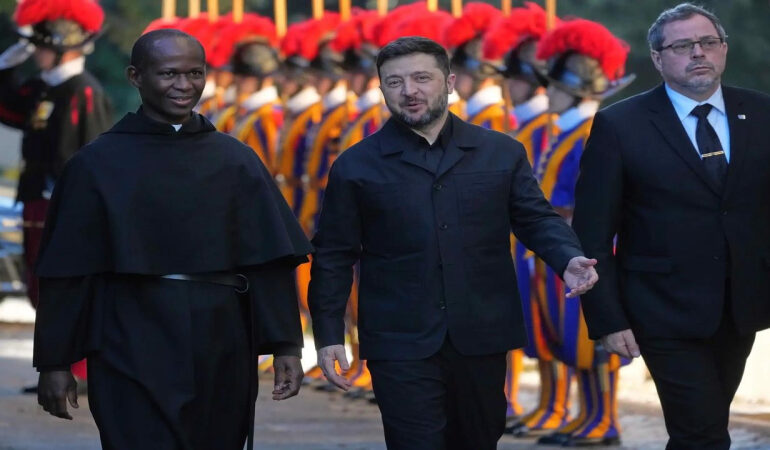

Pope Leo renewed his call for a unified international approach to ending the war in Ukraine, emphasizing that Europe must play a central role in any credible peace agreement and expressing concern over recent signals from Washington suggesting a weakening of the long standing US Europe partnership. Speaking to reporters after meeting Ukrainian President Volodymyr Zelenskyy in Castel Gandolfo, Leo underscored that negotiations excluding European countries would be disconnected from the political and geographic realities of the conflict. He described the alliance between the United States and Europe as an important foundation for global stability and said efforts to undermine it would reshape decades of cooperation. His comments came amid widespread discussion of a new US national security strategy that places greater focus on improving relations with Russia while questioning elements of the transatlantic alliance. Leo noted that while some in the United States might favor this direction, many others view the partnership with Europe as essential, especially as the continent confronts the consequences of a prolonged and destructive war.
During the meeting, Zelenskyy briefed the pope on the latest diplomatic developments, including ongoing work on a three part peace framework addressing political principles, security guarantees and Ukraine’s long term reconstruction. The pope reiterated the Vatican’s support for a ceasefire and stressed that peace must involve concrete gestures from all parties, with particular emphasis on easing the suffering of civilians. Leo again highlighted the situation of Ukrainian children taken into Russian controlled territory, an issue the Vatican has actively sought to address through quiet diplomacy. The Holy See has maintained channels of communication with both Kyiv and Moscow while insisting that neutrality does not mean indifference. In recent months, Leo has met repeatedly with Ukrainian delegations and has also spoken by telephone with Russian President Vladimir Putin, encouraging humanitarian actions that could build trust and open the way for broader negotiations. The Vatican’s engagement has been framed as an effort to protect those most affected by the war while preserving space for dialogue where political positions remain sharply divided.
The pope’s remarks reflect growing concern within the Vatican about geopolitical realignments that risk destabilizing longstanding partnerships fundamental to European peace. He stated that ignoring Europe’s role in Ukraine’s future would not only be unrealistic but could also jeopardize the search for lasting security arrangements. Leo expressed hope that European leaders would seize the moment to work together, pointing to the war’s proximity and its direct impact on the continent’s political and economic future. As winter approaches and humanitarian needs intensify, the Vatican continues to highlight the moral imperative of prioritizing civilian protection and advancing negotiations grounded in justice and accountability. The pope’s comments at Castel Gandolfo reinforce the Holy See’s broader position that peace is not achieved through unilateral plans or shifting alliances but through cooperative frameworks that acknowledge the responsibilities and perspectives of all parties directly affected by conflict. With diplomatic efforts ongoing, the Vatican’s focus remains on promoting unity, safeguarding human dignity and urging leaders to choose pathways that serve the long term stability of Ukraine and Europe.