

Quiet Witness at a Peruvian Monastery Reflects Faith in Its Most Fragile Form
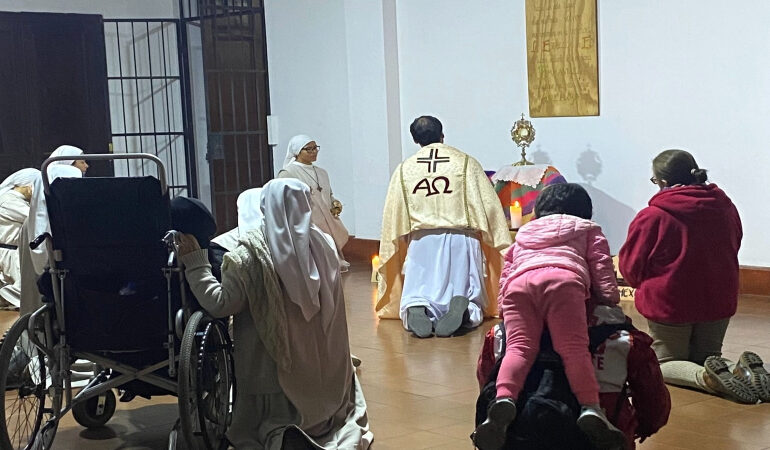

At a monastery in Lima, a small family’s weekly presence has become a quiet sign of faith expressed through vulnerability rather than words. Each Sunday evening, a mother living with illness, her reserved partner, and their young daughter arrive faithfully for prayer, vespers, and adoration. Their gestures are simple and often unnoticed, yet for the religious community they have come to embody a living testimony of trust, dependence, and love. The family does not seek attention, but their way of praying together draws others back to the essentials of belief, reminding observers that faith often speaks most clearly through fragility rather than strength.
During moments of prayer, the family’s posture tells its own story. The mother’s whispered pleas, the silent closeness of her partner, and the child’s spontaneous words reveal a prayer shaped by need rather than formality. The little girl moves freely, sometimes playing, sometimes sitting quietly, and sometimes offering comfort to her mother with a simple phrase or gesture. These moments have left a deep impression on the sisters of the monastery, who see in them a reflection of prayer that rises not from security or abundance, but from dependence on God alone. Their presence challenges assumptions about dignity and order, offering instead a vision of faith rooted in honesty and trust.
The family’s history includes hardship, hospitalization, and social rejection. At times, difficult decisions were made so that the child could be cared for and protected, decisions that required sacrifice rather than recognition. Slowly, change took root. The child began school, found stability, and learned to express affection in place of fear. The transformation did not come through public programs or attention, but through quiet perseverance and care that sought no reward. Even so, the family continues to encounter suspicion and distance in public spaces, often judged by appearance or behavior rather than by their commitment to one another.
For the religious community, these weekly encounters have become a mirror. They prompt reflection on what it means to welcome, to look beyond surface impressions, and to recognize holiness in unexpected forms. Small gestures, such as a child’s drawing or an affectionate embrace, take on deeper meaning as signs of resilience and grace. Echoing the teaching of Pope Leo XIV on the value of closeness to those who suffer, the experience has reinforced a conviction that faith is not perfected through distance or idealization, but through presence. In the quiet rhythm of Sunday prayer, the monastery has found a reminder that the Kingdom of God often approaches gently, carried by fragile steps and simple acts of love.