

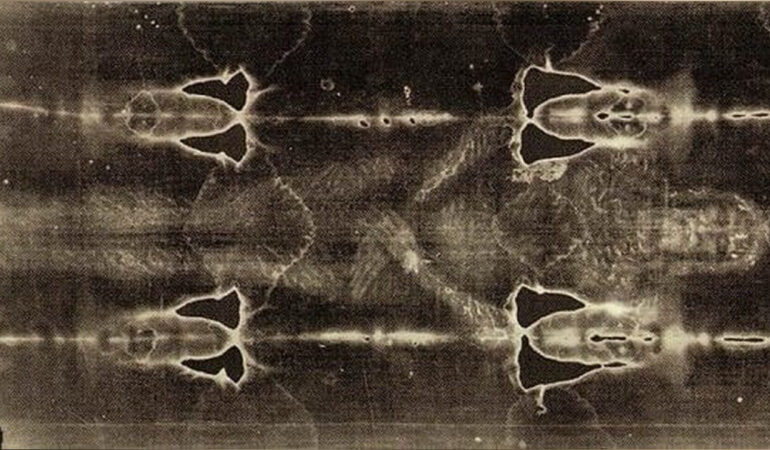

A long running scientific debate surrounding the Shroud of Turin has taken a new turn after specialists challenged a medieval bas relief hypothesis in the same academic journal where it was originally proposed. The journal Archaeometry has published a detailed rebuttal that disputes claims suggesting the Shroud image was produced during the Middle Ages using an artistic relief technique rather than originating from a real human body.
The challenged hypothesis was advanced last year by Brazilian researcher Cicero Moraes, who used digital modeling to argue that a bas relief could explain the anatomical contours visible on the Shroud. According to his study, contact between a cloth and a sculpted surface appeared to correspond more closely to the image than the projection of a three dimensional human body. The proposal attracted significant attention and reignited discussion about the Shroud’s origins.
In response, three internationally recognized Shroud specialists, Tristan Casabianca, Emanuela Marinelli, and Alessandro Piana, submitted a point by point critique that has now been published in Archaeometry. Their response carries particular weight because it appears in the same peer reviewed journal that previously presented Moraes’s work, underscoring the academic rigor of the ongoing discussion.
The authors argue that Moraes’s study is undermined by serious methodological and anatomical flaws. They note that the digital model reproduces only a frontal image, incorrectly reverses right and left in the hands and feet, and adopts a height measurement that falls outside the range generally accepted by researchers. They also criticize the use of imprecise language to claim similarity without supporting measurements, and the reliance on a single historical photograph from 1931 despite the availability of more advanced modern imaging.
Further concerns are raised about the materials used in the modeling. The simulation was carried out on cotton rather than linen, the fabric of the Shroud, and it fails to account for one of the cloth’s most distinctive characteristics, the extreme superficiality of the image, measured at a fraction of a micron in depth. The critics also emphasize that repeated scientific studies have confirmed the presence of blood on the Shroud, a feature they argue is incompatible with known medieval artistic techniques.
The rebuttal places Moraes’s work within a broader historical context, noting that variations of the bas relief theory were already explored and dismissed in academic literature decades ago. It also highlights that the problem of anatomical distortion when a body is wrapped in cloth was examined in detail as early as the beginning of the twentieth century.
Beyond technical issues, the specialists question the historical assumptions behind the medieval forgery claim. They argue that the proposed artistic precedents do not depict a naked, crucified figure shown both front and back, making it difficult to explain how such an unprecedented image could have been conceived and executed in fourteenth century France. Even the art historian cited by Moraes considered the image incompatible with that period and location.
While Moraes has defended his conclusions as strictly methodological, the new publication reinforces the view that explaining an object as singular as the Shroud of Turin requires exceptional scientific precision and historical coherence. The exchange highlights how modern digital tools can inform research, but also how easily conclusions can be overstated without comprehensive evidence.