

Seven Fishes Tradition Carries History to Christmas Tables
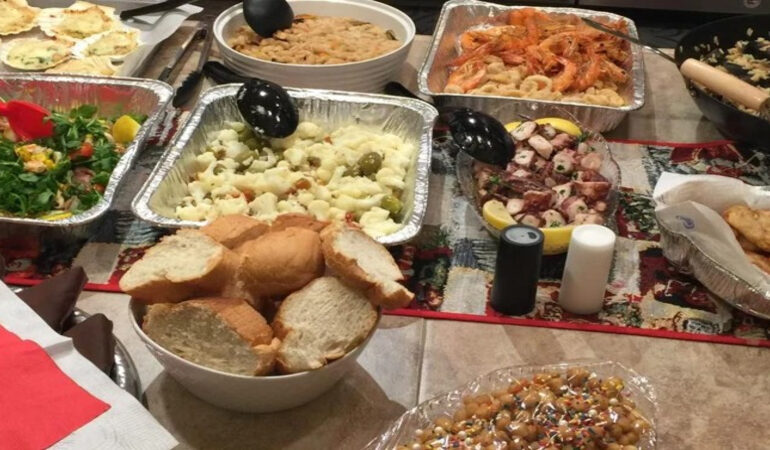

Across Italian and Italian American households, Christmas Eve continues to be marked by the Feast of the Seven Fishes, a tradition shaped less by formal liturgy than by history, scarcity, and memory. Rooted in southern regions of Italy, the custom reflects a time when poverty and geography defined daily life. Coastal communities relied heavily on seafood, particularly during periods when meat consumption was restricted by Church practice. Christmas Eve, observed as a vigil, naturally became a night centered on fish rather than abundance of other foods. Over generations, what began as necessity gradually transformed into ritual. The meal came to signify preparation, patience, and anticipation, aligning with the broader rhythm of waiting that characterizes the night before Christmas. In this way, the feast evolved not as a formal religious observance, but as a domestic expression of faith shaped by circumstance.
The number seven, central to the tradition, carries symbolic resonance within Christian culture, appearing repeatedly in Scripture and theology. Families preparing the meal often point to its association with creation, sacraments, and moral teaching, though interpretations vary widely. There is no single authoritative explanation, and the lack of strict rules has allowed the feast to remain flexible across regions and generations. Dishes differ by household, availability, and taste, ranging from simple preparations to elaborate multi course meals. What unites them is not uniformity, but intention. The act of gathering around a table laden with seafood serves as a reminder of restraint before celebration. Christmas Eve remains distinct from Christmas Day, preserving a sense of pause before the feast that follows.
The tradition crossed borders alongside waves of migration in the late nineteenth and early twentieth centuries, taking root most visibly in the United States. Italian immigrants carried with them not only recipes, but patterns of family life that helped preserve cultural identity in unfamiliar settings. In many cases, the Feast of the Seven Fishes became more prominent abroad than it had been in Italy itself, shaped by nostalgia and adaptation. American kitchens expanded menus, adding courses and variety, while maintaining the core idea of a meatless vigil meal. Over time, the feast came to symbolize continuity across generations, linking grandparents to grandchildren through shared preparation and storytelling. What was once regional became emblematic, representing a broader Italian Catholic heritage.
Today, the Feast of the Seven Fishes occupies a space between faith, culture, and memory. It is not mandated by the Church, nor universally observed, yet it endures because it offers structure to a night defined by waiting. In an era when Christmas celebrations often begin weeks in advance, the tradition preserves a sense of distinction between anticipation and fulfillment. The hours spent cooking, setting the table, and sharing food slow the pace of the season. More than the number of dishes or their complexity, the meal’s meaning lies in its rhythm. It is a reminder that celebration follows preparation, and that traditions rooted in simplicity often endure the longest.