

Unpublished Letter Reveals Benedict XVI’s Final Reflections on Prayer and the Future of Faith
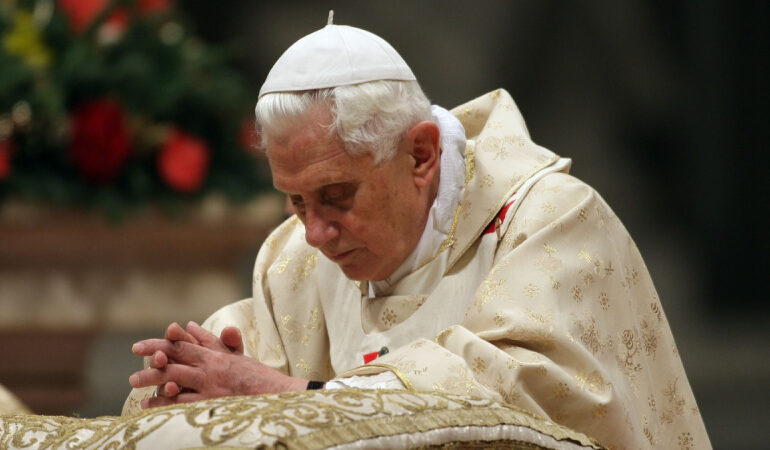

An unpublished letter written by Pope Benedict XVI in April 2021 has shed new light on his final theological reflections, offering a profound meditation on Christian prayer and the future of faith in a rapidly changing world. The text, recently released in an Italian volume dedicated to previously unpublished writings of Joseph Ratzinger, captures the spiritual clarity and doctrinal depth that marked his lifelong service to the Church.
Written little more than a year before his death, the letter is titled Introduction Thoughts on Christian Prayer. In it, Benedict XVI describes prayer as the fundamental religious act and the concrete attempt to enter into contact with God. For him, Christian prayer is distinct because it is always offered together with Jesus Christ and directed to Him. Christ, fully human and fully divine, is presented as the bridge who makes communion with God possible.
Benedict emphasizes that Christ is not only the mediator of prayer but also its guide. Reflecting on the Gospel episode in which the disciples ask Jesus to teach them to pray, he underlines that prayer grows from closeness to Christ. True prayer, he writes, involves both being united with God and consciously abiding in that relationship.
Central to his reflection is the Eucharist. Benedict insists that Christian prayer is anchored in the Eucharist, which he describes as prayer fulfilled with one’s whole being. The Eucharist represents both a critique of superficial worship and the fullest expression of authentic worship. In it, Christ replaces mere ritual and sacrifice with the total gift of His own life. For Benedict, this sacramental realism defines Christianity itself as a living act of prayer.
The letter also addresses misunderstandings about petitionary prayer. Some argue that prayer should consist only of praise rather than requests. Benedict rejects this view, affirming that bringing daily needs before God is not weakness but humility. He points to the structure of the Lord’s Prayer, composed of seven petitions, as clear evidence that asking is intrinsic to Christian faith. Petition, he explains, purifies human desire and orients it toward God.
In his reflections, Benedict acknowledges contemporary uncertainty and the fear that faith may diminish in the future. Yet he does not present prayer as retreat. Instead, he portrays it as the foundation for hope in a world marked by rapid change and existential anxiety. The future of faith, he suggests, depends not on external strength but on deepened communion with Christ.
The publication of this final meditation offers insight into Benedict XVI’s enduring theological vision. Even in retirement and physical frailty, his thought remained precise and spiritually focused. The letter stands as a testament to his conviction that authentic renewal of the Church begins not with strategy, but with prayer rooted in Christ and nourished by the Eucharist.