
Vance Signals Broad Tent as Conservatives Clash Over Identity
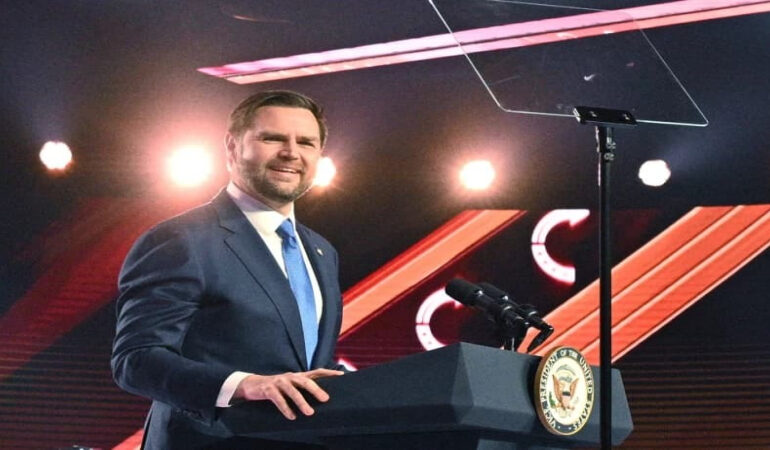

Speaking at Turning Point USA’s annual AmericaFest in Phoenix, JD Vance declined to set explicit boundaries against bigotry within the conservative movement, arguing instead for openness grounded in patriotism rather than ideological purity. Addressing days of internal conflict over antisemitic rhetoric and the presence of controversial figures, Vance said the movement should welcome anyone who loves the country, rejecting what he described as de platforming and internal cancelation. His remarks came amid visible tensions at the gathering, where debates over identity, Israel, and extremism exposed fault lines within a coalition preparing for a future beyond Donald Trump. Vance positioned himself as a unifying figure, framing disagreement as secondary to shared national purpose, while avoiding direct condemnation of figures accused of promoting racial or religious hostility. The stance drew applause from supporters but also sharpened concerns among critics who argue that moral clarity is essential for political credibility.
The four day conference highlighted a conservative movement in transition, with prominent voices openly challenging one another over its direction. Media figures and activists sparred on stage and online, reflecting uncertainty over leadership and priorities in a post Trump landscape. While some speakers denounced conspiratorial rhetoric and warned against tolerating antisemitism, others dismissed talk of an internal civil war as exaggerated or strategically motivated. Vance’s refusal to draw red lines was interpreted by allies as a rejection of factional gatekeeping, yet opponents viewed it as an evasion of responsibility at a moment when political language carries tangible social consequences. The debate underscored a deeper question facing American conservatism: whether unity can be sustained without shared ethical limits. As grassroots organizations like Turning Point USA exert growing influence, the struggle to define acceptable discourse appears set to intensify rather than fade.
Beyond internal disputes, Vance used his address to emphasize the administration’s record on border security, economic policy, and the rollback of diversity initiatives, presenting these efforts as proof of effective governance. He also framed the United States as fundamentally shaped by Christian moral language, remarks that resonated with younger attendees seeking affirmation of religious identity in public life. Support from Turning Point leadership strengthened speculation about Vance’s future ambitions, especially as Republican figures maneuver for position ahead of the next presidential cycle. Yet the unresolved controversies surrounding antisemitism and political extremism remain a test for any leader seeking to hold together a broad and restless coalition. The events in Phoenix revealed a movement energized yet divided, where calls for inclusivity coexist uneasily with fears that moral boundaries are being blurred in the pursuit of power.