




Vietnamese Sisters Grow Organic Mushrooms to Support Community and Fund Student Scholarships
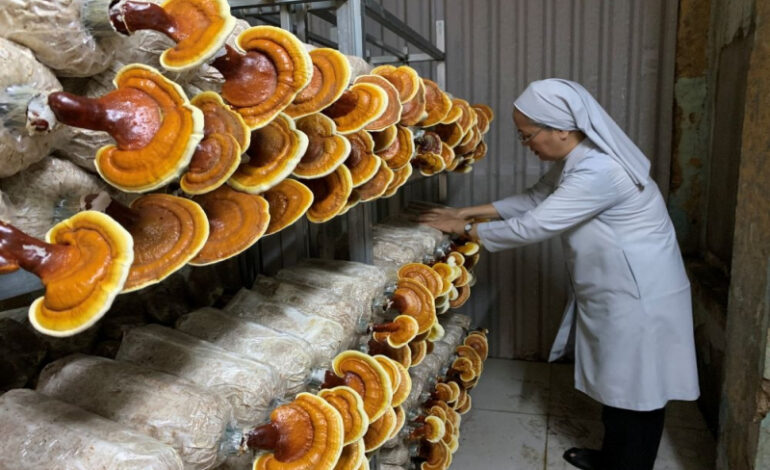

In Ho Chi Minh City, two members of the St. Paul de Chartres congregation have transformed a modest space behind their convent into an organic mushroom garden that now serves both the local community and hundreds of students in need. What began as a small agricultural initiative has evolved into a sustainable social mission rooted in environmental care and educational support.
Each morning before the tropical heat intensifies, Sr. Agathe Tran Thi Mong Huyen and Sr. Marie Nguyen Thi Minh Hoa step into their 328 square foot growing house. Inside, roughly 4,000 mushroom growing bags are arranged neatly on iron shelves. The sisters monitor humidity levels, water the walkways between the shelves, and carefully track growth cycles. Five varieties are cultivated, including abalone and reishi mushrooms, each requiring different techniques and months of patient care.
The project began in August with guidance from a local company that supplied organic growing materials and technical training. Initial investment totaled about 100 million Vietnamese dong, equivalent to approximately 3,850 US dollars. Since then, the sisters have completed seven harvest cycles, yielding between 25 and 30 kilograms per cycle.
The cultivation process follows strict organic principles. Growing bags are prepared using sawdust, bean husks, and nutrients, then sterilized before inoculation with spores. The structure is designed for natural airflow and temperature control, with insulated roofing and mist systems to maintain ideal humidity. Purified water from a nearby parish filtration system ensures balanced pH levels. No chemical fertilizers or pesticides are used.
Waste is reused in a closed cycle. Spent growing bags are composted to fertilize convent gardens, and damaged mushrooms are dried and processed into seasoning powder. The sisters say this approach reflects their commitment to environmental stewardship and human health.
The mushrooms are sold to religious communities, kindergartens, families, and centers supporting children with disabilities. Locally, they have earned a nickname that translates to the sisters’ mushrooms, reflecting both their quality and the trust they have built among customers.
Beyond agriculture, the heart of the initiative lies in education. Sales fund scholarships for approximately 200 students from preschool to university level across five dioceses. Many beneficiaries come from families affected by poverty, illness, or the economic fallout of the pandemic. The sisters view the project as a long term solution that reduces dependence on unpredictable donations.
Community members have also benefited from the knowledge shared. Visitors have learned organic cultivation techniques and expressed interest in replicating the model in rural areas to reduce exposure to chemical farming practices.
For the sisters, mushroom cultivation has become a new form of ministry, blending faith, sustainability, and social responsibility. By linking environmental care with educational opportunity, they have created a model of community service that addresses both immediate nutritional needs and the long term future of young students.