Nazareth Remains a Living Witness to the Mystery of the Incarnation

Nazareth, a historic city located among the hills of Galilee, continues to hold profound spiritual importance for Christians around the world as the place where the Incarnation of Christ began. Known as Natzrat in Hebrew and an Nasira in Arabic, the city today has a population approaching eighty thousand and stands as the largest Arab city within the State of Israel. Nazareth’s religious diversity is distinctive. Roughly one third of its residents are Christian, representing a wide range of traditions including Greek Orthodox, Latin Rite Catholics, Melkite Greek Catholics, Maronites, Copts, Anglicans and Lutherans. The Latin Catholic parish alone serves nearly nine thousand faithful, making it the largest Catholic parish community in the Holy Land.
Despite its modern growth, Nazareth was once an obscure village barely recorded in ancient historical writings. The absence of the town from the Old Testament and other early sources suggests that it held little importance in the wider political or cultural landscape of the ancient world. Even within the Gospel narratives this humble reputation appears in the question posed by Nathanael in the Gospel of John asking whether anything good could come from Nazareth. Yet the city entered world history through the events described in the New Testament. According to Christian belief it was here that the angel Gabriel announced to the Virgin Mary that she would give birth to Jesus, marking the moment when the Word became flesh and the history of salvation took a decisive turn.
Archaeological investigations over the last century have helped scholars reconstruct the appearance of Nazareth during the time of Jesus. Excavations carried out by Franciscan archaeologists uncovered evidence of a small rural settlement built along a hillside. Stone houses, caves carved into the rock, water cisterns and storage silos indicate a modest agricultural community typical of the region in the first century. Ceramic remains suggest that the area had been inhabited for many centuries before the birth of Christ. These discoveries provide historical context for the Gospel accounts describing Jesus’ early life in Nazareth, where he lived with Mary and Joseph and spent most of his first thirty years in ordinary daily life before beginning his public ministry.
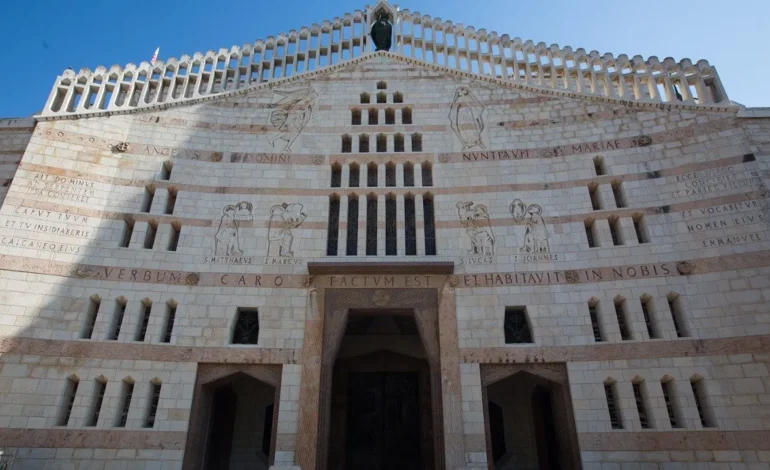
At the heart of the city stands the Basilica of the Annunciation, one of the most significant Christian sanctuaries in the world. The modern basilica was designed by Italian architect Giovanni Muzio and consecrated in 1969. Built over earlier layers of churches and archaeological remains, the structure preserves nearly two thousand years of Christian devotion associated with the site. The lower level of the basilica surrounds the Grotto of the Annunciation, traditionally believed to be the location where the angel Gabriel spoke to Mary. The atmosphere of this space is intentionally subdued, encouraging prayer and reflection on the mystery of the Incarnation that Christians believe occurred at this very place.
The upper level of the basilica contrasts with the quiet darkness below by opening into a space filled with light dedicated to Mary as Mother of the Church. Artistic works from many countries line the walls, portraying the Virgin Mary according to different cultural traditions from across the world. These images symbolize the global spread of Christianity and the universality of the Christian message. Architectural features of the basilica also reflect theological themes, including large bronze doors that illustrate scenes from both the Old and New Testaments and a massive dome shaped like an inverted lily, a traditional symbol of Mary’s purity.
Nazareth’s history has not been free from conflict and hardship. The city experienced cycles of destruction and rebuilding over the centuries. During the Crusader period a large cathedral was constructed on the site, but it was destroyed after the Christian defeat at the Battle of Hattin in the twelfth century and the later campaigns of Sultan Baibars. The Franciscan Custody of the Holy Land eventually returned to Nazareth in the seventeenth century and played a decisive role in restoring Christian presence and preserving the holy places associated with the life of Jesus. Over time the Franciscans acquired much of the surrounding land and continued to safeguard the sanctuaries that remain central to Christian pilgrimage.
Today Nazareth stands as a meeting point of cultures, religions and histories within the complex landscape of the Holy Land. The city’s streets connect ancient traditions with modern daily life while its churches continue to attract pilgrims from every continent. For many visitors the Basilica of the Annunciation represents more than a historic monument. It serves as a reminder of the belief that God entered human history in an ordinary place among ordinary people. Nazareth, once an unknown village, remains a powerful symbol of humility and faith within the broader narrative of Christian history.