




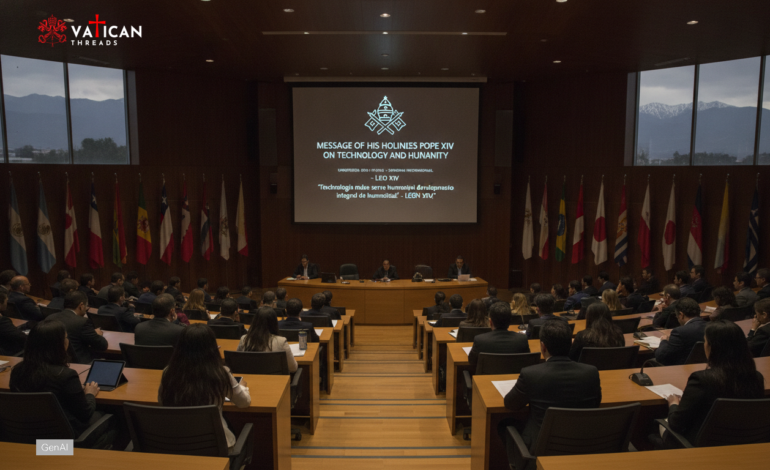

Pope Leo XIV technology: why truth must guide innovation
In commentary circulating about Pope Leo XIV technology and public ethics, digital tools are often framed as moral instruments that should be judged by what they serve, not only by what they can do. In those summaries, he is described as arguing that innovation should advance truth and the common good in public life, rather than distort reality for influence or profit. However, these points are presented without a specific, citable Vatican transcript or dated text in this draft. The same accounts typically attribute responsibility to builders, investors, publishers, and public officials, warning that technical power without ethical direction can weaken trust, though the precise wording and context are not verified here. The recurring theme is a practical test for platforms: whether they help communities recognize reality and act with solidarity, as commentators have described, including in 2026 discussions.
Communication risks: AI spam, virality, and verification
In reporting and analysis about Pope Leo XIV technology and communications, he is often said to have highlighted how public discourse can be manipulated when speed and virality outrun verification, leaving ordinary people to sort truth from engineered noise. According to available reports, commentators connect these concerns to the growing challenge of synthetic content and low-quality automation, highlighted by industry responses such as TechCrunch coverage of LinkedIn reporting features for AI generated content. In the same context, NFT Market Moves: Essential Investor Insights is used as an example of how digital markets can reward attention cycles that pressure communicators to simplify or sensationalize. He is also described as calling for careful sourcing, accountable correction practices, and protection of reputations as a civic duty, although this article does not provide a dated primary-source citation for those directives.
Human dignity and accountable digital decisions
As summarized in various write-ups, Pope Leo XIV technology guidance is presented as emphasizing that human dignity should remain the fixed point when deploying data-driven systems in schools, workplaces, and public services. However, this draft does not include a link to a specific address, document, or transcript confirming the claim. He is also reported to have warned that ranking people by opaque scores can quietly normalize exclusion, especially when individuals cannot challenge errors or understand why a decision was made. A related internal explainer appears in Pope Leo XIV 1982: origins of his peace message, and these summaries further suggest he linked the dignity question to pastoral realities, noting that online harassment and dehumanizing language can spill into parish life and family relationships. Overall, the approach is commonly described as favoring tools that are explainable, appealable, and designed to protect the vulnerable, though the exact phrasing is not attributed to a primary text here.
Global impact: supply chains, regulation, and trust
In commentary about the Pope’s role in debates on digital governance, his intervention is described as landing just as governments and companies debate regulation, liability, and standards for automated decision making across borders. This is contextual framing rather than a documented, dated quotation. He is often characterized as arguing that global technology supply chains make local harms international, because a policy choice in one market can shape speech norms and data practices elsewhere. However, this draft does not provide an official source for that statement. Related Church context appears in Pope Leo XIV Spain visit: dates, sites, aims, which connects his public agenda to governance and social concerns. He is also said to have urged Catholic leaders to engage lawmakers and industry with concrete ethical demands, especially where surveillance and targeted persuasion are expanding. In this framing, technology is treated as not morally neutral once it structures who is heard and who is ignored, a conclusion attributed here to secondary summaries rather than a primary document.
Church practice: competence, security, and credible witness
For Church communications, summaries of Pope Leo XIV technology guidance describe him as directing communicators to adopt digital tools with discipline, emphasizing that credibility is strengthened by accurate sourcing, transparent corrections, and respectful tone. This draft does not cite an official directive or dated address. He is also reported to have encouraged technical competence inside dioceses so that data protection, content stewardship, and cybersecurity are treated as integral to ministry. Commentators further attribute to him a warning against evangelization strategies built primarily on engagement metrics that reward provocation, though no primary-source text is quoted here. The overall aim is typically described as a digital presence that serves people rather than harvesting them.