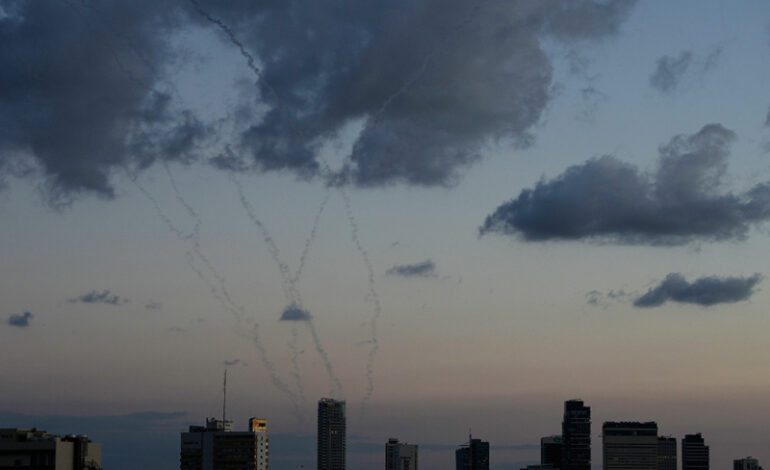

Catholic pilgrimage groups visiting the Holy Land have found themselves stranded in Israel and the West Bank after a sharp escalation in hostilities involving the United States, Israel, and Iran led to widespread airspace closures across the Middle East. Commercial flights were grounded or suspended as missile exchanges intensified, leaving travelers with limited options for departure.
International airlines halted operations to and from Tel Aviv as security conditions deteriorated. Although Israeli authorities later permitted limited flight activity, schedules remain unstable and subject to sudden cancellation. Air raid sirens have repeatedly sounded in Jerusalem and central Israel, sending residents and visitors into shelters, while tightened security measures in the West Bank have complicated road travel between Palestinian cities and Jerusalem.
Among those affected was a group of 17 Italian and Italian American pilgrims led by Father Luigi Portarulo, parochial vicar at the Basilica of St. Patrick’s Old Cathedral in New York City. The group had visited Nazareth and Bethlehem and was traveling toward Masada near the Dead Sea when emergency alerts began sounding on their phones. Their bus driver turned back in the desert as missiles were visible and audible overhead.
The group abandoned their planned itinerary and returned toward Bethlehem before moving to Jerusalem after learning that a hotel there had a reinforced bunker. For two days and nights, they sheltered amid repeated alarms. According to Father Portarulo, the pilgrims descended to safety multiple times as sirens warned of incoming projectiles. A ballistic missile struck West Jerusalem close enough to shake their building, and they later learned that two civilians had been killed nearby.
With airspace closures extending across the region, pilgrims explored alternative routes, including overland travel to Jordan or Egypt in hopes of finding functioning airports. Even beyond Israel’s borders, however, the security atmosphere remained tense, with military aircraft frequently overhead.
The Franciscan Custody of the Holy Land has assisted stranded groups while maintaining shelter protocols for local communities. Franciscan Brother Francesco Ielpo, appointed custos in 2025, experienced the disruption firsthand when his flight from Milan to Tel Aviv was forced to turn back midair. He later reached Jerusalem via Amman, Jordan. Since then, Franciscan facilities have hosted pilgrims from Italy, China, and other countries awaiting guidance from authorities.
Church compounds in Jerusalem and Jaffa are integrated into Israel’s civil defense alert system, enabling rapid movement to protected spaces when warnings are issued. Franciscan houses have opened bunkers not only to pilgrims but also to neighboring families, reflecting local solidarity during the crisis.
The conflict coincides with the beginning of a Franciscan commemorative year marking 800 years since the death of St. Francis of Assisi. The anniversary recalls his journey to the Middle East during the Fifth Crusade and his encounter with the Sultan of Egypt, often cited as a symbol of dialogue amid war. For now, however, embassies continue advising caution as pilgrimage operators report mounting cancellations and uncertainty surrounding upcoming travel seasons.