



Pope Leo XIV and the July 4 Vatican meeting
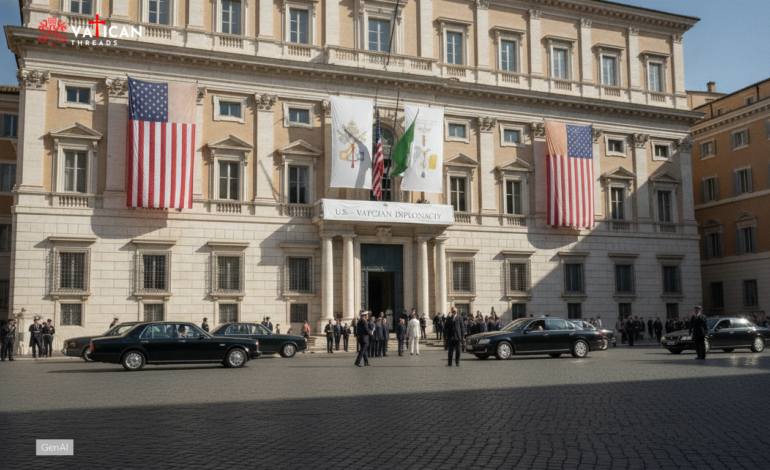
Pope Leo XIV marked the Fourth of July at the Vatican in a diplomatic setting with the United States Ambassador to the Holy See, according to standard Vatican press guidance and customary diplomatic practice. The Holy See appeared to treat the observance primarily as protocol for a national day rather than a spectacle, and Pope Leo XIV was described in general terms as touching on religious freedom, conscience protections, and humanitarian priorities, based on broad themes typically cited in official readouts. While no detailed communique was released beyond standard press guidance, officials characterized the meeting as part of ongoing contacts between the Holy See and the US mission, with general references to public service and community resilience.
Why the Vatican observes US Independence Day
In Rome, national day receptions often serve as working moments where diplomats and Church officials explore areas of practical cooperation, as diplomats and Vatican watchers commonly note. In that context, the Fourth of July gathering was portrayed as linking civic freedom with responsibilities toward vulnerable communities, including migrants, and as reflecting a shared interest in peacebuilding and conflict mediation, though specific policy commitments were not publicly detailed, and related Vatican coverage under Pope Leo XIV has highlighted service and outreach themes in other settings, including Pope’s lunch with the poor: fragility as a source of strength for communities. For a separate view on how public ethics debates can shape regulation across institutions, see OpenAI GPT launch: new model details and reactions, as the reception otherwise remained framed as protocol rather than a policy forum.
Diplomatic signals from the Holy See and US mission
Public readouts, where available, tended to stress continuity rather than any single dispute, and cooperation was described in broad categories such as humanitarian aid, peace efforts, and regular diplomatic contact, according to general press guidance rather than detailed minutes. Some observers have noted that informal Vatican chatter can attach shorthand labels to themes, but no formal details were provided publicly on governance or finance discussions in connection with the July 4 event, and separately, Vatican governance developments have drawn attention recently to institutional oversight and appointments, including IOR appointment adds Marina Natale to oversight board. Overall, the reception appeared intended to keep channels predictable and professional, using protocol as a vehicle for continued exchange.
Catholic community and cultural meaning in Rome
Culturally, the moment suggested how national-identity celebrations can sit alongside the Holy See’s universal mission without necessarily turning into domestic politics in Rome. For American Catholics living in Rome and for diplomats assigned to the city, such receptions are commonly understood as a sign of welcome and a reminder that civic traditions can be expressed within an explicitly religious environment, and Vatican-linked outreach stories have also reinforced the theme that public credibility is strengthened through visible service, including Pope Leo XIV shares lunch with the poor at Castel Gandolfo. In that light, Pope Leo XIV’s July 4 appearance functioned as a diplomatic touchpoint as well as a cultural one.
What this could mean for US Vatican ties next
The forward-looking takeaway from the July 4 observance could suggest a preference for stable cooperation even as political cycles change. The Holy See is widely described as prioritizing humanitarian corridors, religious liberty concerns, and mediation in conflict zones, though emphases can vary by context and are not always spelled out in brief reception readouts, and related reporting on Vatican engagement in humanitarian response has underscored similar institutional themes, including Vatican earthquake response after Venezuela quakes strike. Likewise, the US mission has often publicly portrayed Vatican engagement as useful for outreach in fragile regions, even when details remain quiet. Future coordination is therefore likely to emphasize practical projects and continued dialogue rather than headline diplomacy, especially where assistance can be delivered through trusted networks, as commentators often note. The event ended as a measured reaffirmation of routine working relationships, as far as publicly available information indicates.