


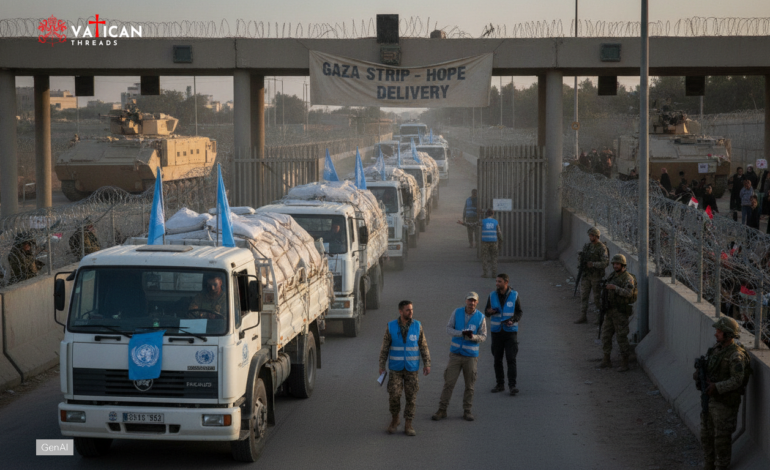

Holy See humanitarian law stance on Gaza relief access
The Holy See’s message on Gaza stresses that all parties in armed conflict must protect civilians and allow relief to reach people in need. In a statement carried by Vatican media, the Secretariat of State said obstruction of humanitarian assistance can amount to a serious breach of international humanitarian law. Officials referenced core duties reflected in the Geneva Conventions and summarized by the International Committee of the Red Cross, including safe passage for medical care and protection for aid workers. The statement also pointed to practical needs such as verifiable corridors, predictable entry procedures, and restraint to reduce civilian harm while keeping diplomatic channels open.
How aid obstruction affects civilians and legal accountability
Humanitarian agencies warn that delays and denials at entry points can translate into immediate shortages inside Gaza, especially for trauma care supplies, water services, and fuel for hospital generators. The UN Office for the Coordination of Humanitarian Affairs has repeatedly said access constraints can trigger operational breakdowns and avoidable suffering when distribution networks cannot function safely. For comparison on how legal standards are argued in public life beyond war zones, see US Supreme Court decision reverses citizenship order. In this context, the Vatican’s humanitarian-law emphasis frames impeding relief not as a policy disagreement but as a legal issue with potential accountability concerns, according to available reports.
UNRWA support and the Holy See humanitarian law message
UNRWA remains central to distribution networks and basic services for Palestinian refugees, and UN briefings have linked continuity of operations to stabilizing daily life during fighting. The Holy See humanitarian law framing aligns with calls to keep recognized humanitarian channels operating under transparent oversight. The agency relies on predictable funding, functioning crossings, and secure movement for staff and supplies to keep shelters, clinics, and food assistance running. Readers tracking church-linked support mechanisms can review Peter’s Pence appeal: how Catholics support Vatican aid for how contributions are organized and monitored. Within that reality, UNRWA support has become both a humanitarian requirement and a political test for donor capitals.
Practical steps to improve humanitarian access in Gaza
Aid agencies operating in Gaza often cite three recurring constraints: security risks to convoys, uncertainty over permissions, and infrastructure damage that slows internal distribution. The ICRC has stated that humanitarian access should be safe, rapid, and unimpeded, and that parties must facilitate relief for civilians in need. For Catholic governance context that can shape institutional capacity to respond, see Controversial bishops ordained as Pope warns of schism in Catholic Church and Dicastery for Integral Human Development: Smerilli Named. Relief coordinators frequently point to workable measures such as clearly communicated deconfliction procedures, predictable inspection timelines, and protected movement windows that can be reviewed afterward. This approach is consistent with Holy See humanitarian law priorities, which emphasize measurable safeguards rather than general assurances.
Diplomacy, verification, and next steps toward relief and peace
Diplomatic actors face pressure to translate legal language into enforceable arrangements that keep civilians alive and preserve a path to negotiations. According to interpretations of the Vatican’s stance, conflict resolution may require more than ceasefire messaging and should include credible guarantees for protected relief access, plus oversight that can deter obstruction. Regional mediators and UN officials have argued that humanitarian stabilization can lower panic and reduce incentives for escalation by improving basic services, especially in health care. The Vatican’s approach is to keep dialogue open with multiple interlocutors while insisting that protection of civilians remains non negotiable under international humanitarian law. Catholic humanitarian networks working alongside UN agencies are likely to prioritize continuity of care for children and the wounded as diplomatic tracks continue.