

Iran talks and Parolin’s call for dialogue
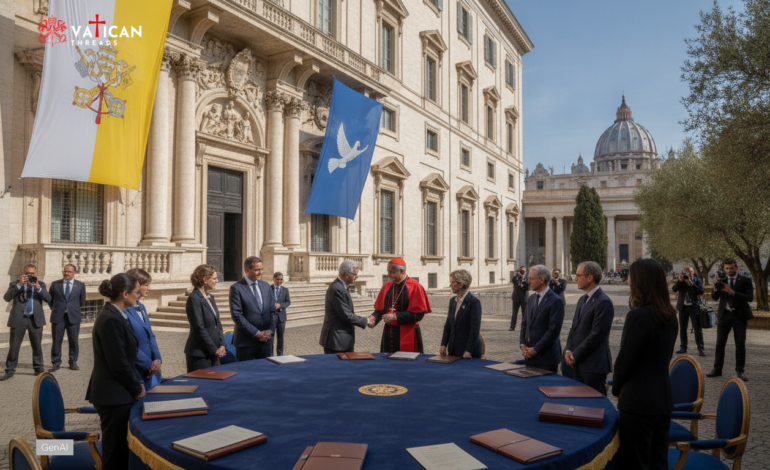
Iran talks have returned to the center of Cardinal Pietro Parolin’s public message, as noted by Vatican media, as the Holy See urges sustained diplomatic engagement with Tehran while other peace tracks, including Ukraine, remain stalled. In remarks reported by Vatican media in July 2026, the Vatican Secretary of State framed Iran talks as a practical tool to lower regional tensions and protect civilians. He argued that keeping channels open can help prevent miscalculation and rebuild minimum trust between parties that rarely meet directly. Parolin presented the Vatican approach as consistent with the Church’s preference for negotiation over escalation, even when outcomes are uncertain and the pace is slow.
Why renewed Iran talks matter now
Vatican officials often emphasize process over headlines, noting that negotiations can move in quiet stages before producing visible results. The Holy See’s diplomacy frequently focuses on humanitarian access, prisoner issues, and protection of religious communities, areas that can sometimes advance even when politics is rigid. In Parolin’s framing, as reported by Vatican outlets, Iran talks can function as a stabilizing track alongside other regional contacts when security crises distract major capitals; for a snapshot of how regulatory debates can shift quickly under pressure, see Google EU regulation warning: EU rules may curb rivalry as an example of fast changing negotiating terrain. Vatican media reporting in July 2026 has similarly suggested that quiet stages can matter as much as public breakthroughs when tensions rise.
Parsing the implications of Vatican diplomacy amid the Ukraine war
Church diplomacy is being tested by the continuing war in Ukraine, where the Vatican has repeatedly urged respect for international humanitarian norms and the pursuit of dialogue, as reflected in Vatican News coverage. Vatican News cited Archbishop Paul Richard Gallagher in a July 2026 interview describing Ukrainians as a source of hope amid suffering, underscoring a message that endurance and negotiation are not mutually exclusive; readers can compare that approach with the Ukraine track in Papal visit Ukraine: Gallagher on hope and diplomacy and the related Vatican News report Archbishop Gallagher: Ukraine’s people inspire hope amid suffering. Parolin has voiced a similar line in public comments covered by Vatican media, saying that peace negotiations require persistence even when battlefield realities make compromise difficult. The same July 2026 framing has been used to argue that dialogue can be pursued without minimizing the suffering caused by the war.
Contextualizing Iran-Vatican relations: channels and constraints
Iran and the Holy See have maintained formal diplomatic relations for decades, enabling periodic consultations even when Tehran’s ties with many Western governments are strained, as is widely noted in public diplomatic records and reporting. The Vatican has used those channels to raise concerns about regional stability, minority protections, and humanitarian principles while generally avoiding alignment with military blocs, according to longstanding Holy See diplomatic practice described in its public messaging. In recent months, Vatican communication has stressed keeping lines open with all relevant actors, according to Vatican media reporting, which is one reason Iran talks have featured more prominently in recent remarks; for a similar Vatican emphasis on ethical reconstruction and public trust, see Venezuelan bishops urge ethics in quake rebuilding. The aim is not theatrical mediation but practical contact that can reduce risks, especially when regional crises interact with the Ukraine conflict and widen polarization.
What comes next for Iran talks and humanitarian priorities
The Vatican signals that the next phase depends on whether parties treat negotiation as a durable commitment rather than a tactical pause, as suggested in Parolin’s public framing noted by Vatican media. His approach points to incremental steps, including confidence-building measures that can make broader settlements possible later, and in that context Iran talks are linked to sustained diplomatic engagement rather than short-term optics. At the same time, he links diplomacy to concrete humanitarian priorities, reflecting the Holy See’s stated insistence that civilians must not be treated as leverage; Vatican News reporting in July 2026 has also highlighted civilian harm in active conflicts, including Gaza, to keep policy grounded in human costs rather than abstractions; see Civilians continue to bear brunt of Gaza conflict. For the Holy See, credibility is tied to consistency in backing dialogue, condemning attacks on noncombatants, and supporting any serious pathway toward reconciliation.