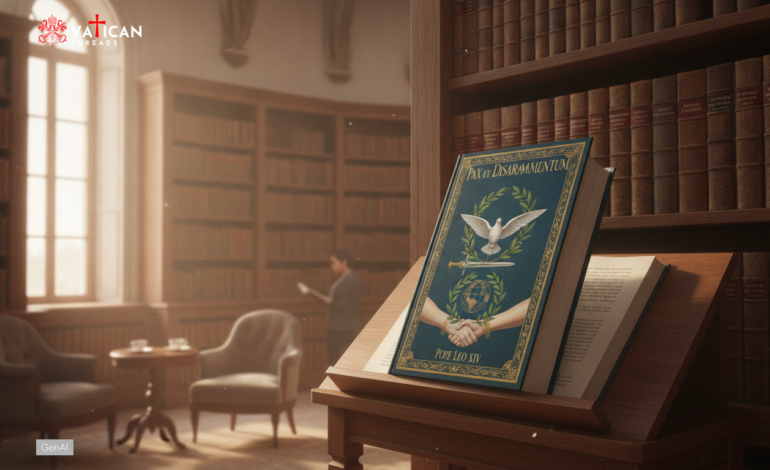

Pope Leo XIV book sets a diplomatic case for peace
Pope Leo XIV presented a new volume focused on peacebuilding as a concrete political and moral task for states and societies. According to reports from Vatican News dated July 2026, he framed peace as a work of institutions, conscience, and patient negotiation rather than deterrence rhetoric. The volume was described in that reporting as a call to “moral mobilization” aimed at leaders, diplomats, and ordinary believers. The Pope Leo XIV book is presented as a synthesis of the pontificate’s diplomatic tone, intended to be read beyond church circles. In the same Vatican News account, he emphasized dialogue that protects civilians and restores trust between rivals, especially where long conflicts have hardened public expectations.
How the book links disarmament to security
The publication presents disarmament as a measurable pathway and ties it to verification, transparency, and reciprocal commitments, according to a curator interview published by https://www.vaticannews.va/en/pope/news/2026-07/pope-leo-peace-alessandro-banfi-curation-book-disarmament.html. For a parallel on how safeguards and credibility shape decision making under pressure, see https://londonews.com/thames-water-nationalisation-risk-lenders-back-golden-share/. In that context, according to available reports, the Pope suggests that nuclear weapons should not be treated as ordinary tools of policy because their use would exceed humanitarian limits.
Pope Leo XIV book themes in ‘Disarmed and Disarming’
The book, titled “Disarmed and Disarming,” lays out its argument around moral clarity and practical steps, including diplomatic persistence and credible arms control, as described by Vatican News in its presentation of the project. In discussion around pope leo xiv 2025 priorities, Vatican News characterized the text as a bridge between spiritual exhortation and concrete policy language. Vatican communications have also linked the project to wider church initiatives on creation and human development, including institutional efforts described in Borgo Laudato si Exhibit Debuts in Vatican Gardens. A notable thread, as summarized in that coverage, is the insistence that disarmament requires supportive social conditions, such as education for peace and leadership that rejects fear-based politics. The writing is positioned as accessible to non-specialists while still addressing security dilemmas.
What the publication implies for nuclear policy
Commentary in and around Vatican reporting suggests the volume reinforces the Holy See’s long-standing support for nuclear arms control and eventual elimination. Related coverage on Vatican diplomacy appears in Archbishop Gallagher Kyiv visit urges prayer for peace. Within the text’s framing as described by Vatican News, the “security” promised by nuclear weapons is treated as unstable because it relies on perpetual readiness to inflict indiscriminate harm. The argument also aligns with humanitarian-law concerns commonly raised in multilateral forums, where disproportionate civilian effects are central, though the article does not present this as a technical legal brief. Some coverage has also pointed to the Pope’s identity as robert francis prevost pope leo xiv; to avoid over-specific biographical claims beyond the linked reporting, it is more cautiously described as an emphasis on governance and pastoral experience shaping a preference for negotiated outcomes over symbolic threats.
Reception and context around the Pope Leo XIV book
Reactions carried by Vatican News indicate that church leaders view the text as pastoral guidance with geopolitical implications, particularly for communities living under constant insecurity. In that same reporting context, clergy and Catholic peace groups are presented as seeing the writing as useful for preaching and civic education because it translates ethical principles into governmental responsibility. In the same July 2026 news cycle, a separate Vatican News dispatch on the region’s humanitarian crisis, https://www.vaticannews.va/en/world/news/2026-07/gaza-israel-palestinians-hamas-war-deaths-humanitarian-crisis.html, highlighted how civilians bear heavy costs even without nuclear escalation. More broadly, the surrounding discussion has focused on how religious voices can influence security debates without claiming to replace technical expertise. In that setting, the Pope Leo XIV book is presented as an attempt to keep verified disarmament and diplomacy on the agenda as a matter of responsibility rather than ideology.