Pope Leo Calls for Renewed Middle East Stability During Final Hours in Lebanon
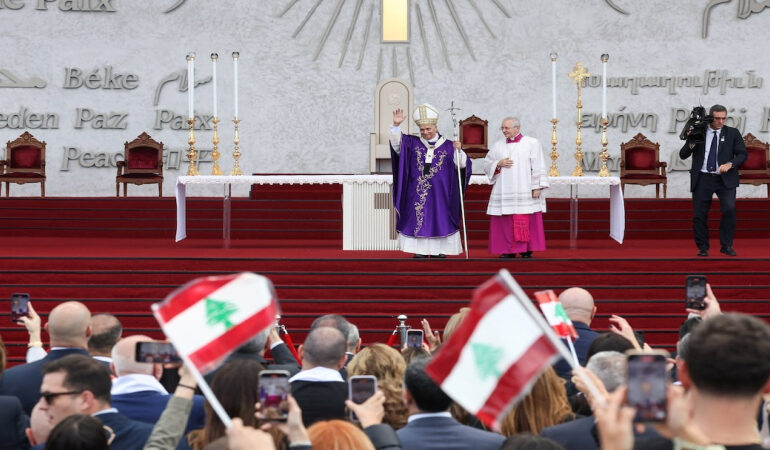

Pope Leo concluded his visit to Lebanon with a direct plea for leaders across the Middle East to reconsider the direction of escalating regional tensions and to work toward conditions that protect human dignity. Addressing an estimated one hundred fifty thousand people along Beirut’s waterfront, he highlighted the moral and social costs borne by communities living under prolonged instability. His remarks emphasized the need for long term political responsibility, arguing that societies cannot rebuild if distrust and retaliation remain the default response to conflict. The visit, which followed several days of engagements with religious authorities and social institutions, marked the end of the pontiff’s first international journey since assuming leadership of the Catholic Church. Observers noted that his closing message carried both pastoral encouragement and a subtle push for diplomatic recalibration within a region still struggling to recover from overlapping military and economic crises.
Throughout his stay, Pope Leo engaged with leaders from multiple faith traditions, urging them to prioritize reconciliation and to maintain communication channels even during periods of uncertainty. The pope referenced Lebanon’s repeated cycles of political paralysis and financial distress, noting that public confidence cannot return unless structural reforms are consistently pursued. His remarks gained additional resonance in light of last year’s conflict involving Israel and Hezbollah, followed by continued cross-border strikes that have disrupted livelihoods and heightened humanitarian pressure. The pontiff warned that humanity’s future becomes increasingly fragile when violence overshadows reason, and he appealed to international actors to invest in dialogue rather than military escalation. For Lebanon, a country carrying the weight of refugee inflows and infrastructure decline, the pope’s message signaled a call to protect social cohesion and avoid further erosion of institutions that remain vital to recovery.
Earlier in the day, the pope visited a psychiatric hospital operated by Franciscan nuns and then traveled to the Beirut port to pray near the remnants of the 2020 chemical explosion. The stop was particularly symbolic for families seeking accountability after years of stalled investigations. Pope Leo placed a wreath at the memorial and met survivors and relatives, offering individual rosaries and words of comfort. Many attendees expressed hope that his presence would renew pressure for justice and reinforce global awareness of Lebanon’s unresolved grievances. Volunteers and young citizens described the gathering as a rare moment that unified a country challenged by political fragmentation. As the pontiff departed for Rome, he reiterated his plea for an end to hostilities in Lebanon’s southern regions and encouraged national leaders to respond to the aspirations of their people with renewed clarity and resolve.